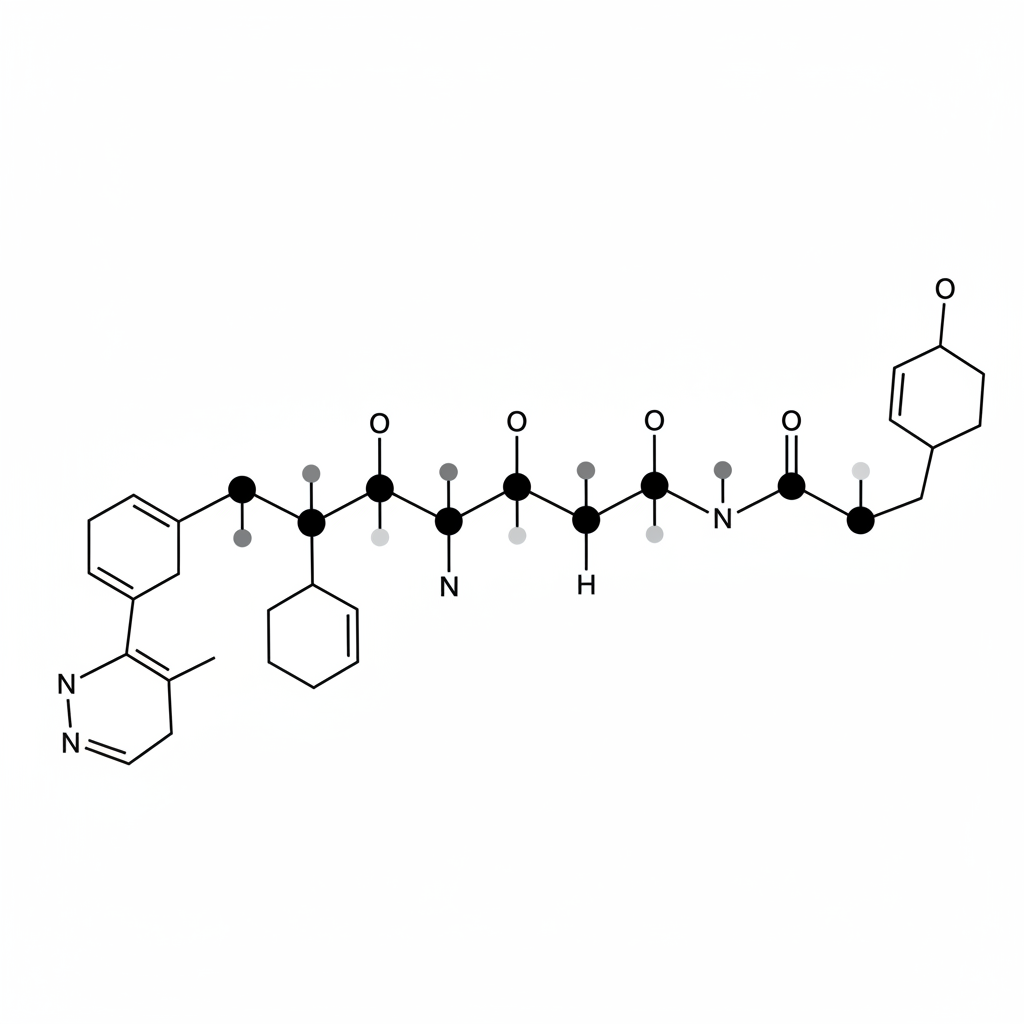
Research synthesis only; not medical advice. This guide explains the concepts used across the atlas and how to navigate it. Nothing here should be taken as a recommendation to use, purchase, or self-administer any substance.
What is a peptide?
A peptide is a short chain of amino acids — the same building blocks that make up proteins. The difference is mostly a matter of length. While proteins can be hundreds or thousands of amino acids long, peptides are typically under 40–50 amino acids.
Think of amino acids as individual beads on a string. A peptide is a short string, a protein is a long one. There is no hard cutoff, but the shorter length means peptides are often easier to synthesise, modify, and study than full proteins.
Some peptides occur naturally in the body (like oxytocin or insulin). Others are designed in a laboratory to mimic or block natural signals.
How do peptides work in the body?
Most peptides act as signalling molecules. They are released by one cell, travel a short or long distance, and bind to a receptor on another cell. This binding triggers a specific response — releasing a hormone, turning a gene on or off, or changing how a cell behaves.
The key idea is that a peptide is like a key, and its receptor is like a lock. Only the right key fits. This specificity is what makes peptides useful: they can target very precise biological pathways.
Common examples include:
Expansion of the abbreviation used in the monographs: glucagon-like peptide-1 receptor agonist. The atlas does not define the pharmacology of this class; see the monograph for what is documented about a specific compound. Definition source: Neutral gloss; the abbreviation is printed on the tirzepatide monograph but the atlas does not define the class pharmacology · Glossary (e.g. semaglutide, tirzepatide) that mimic a natural gut hormone to regulate blood sugar and appetite.
GnRH analogues (e.g. leuprolide, nafarelin) that alter reproductive hormone signalling.
Growth-hormone secretagogues (e.g. ipamorelin, tesamorelin) that stimulate the release of growth hormone.
The five entry types in this atlas
Not all peptides in the catalog are the same kind of thing. The atlas separates entries into five categories, each with different evidence standards and caveats:
1. Approved drugs
Peptides that have been evaluated by a regulator (FDA, EMA, MHRA, etc.) for quality, safety, and efficacy in a specific indication. Examples: semaglutide, octreotide, desmopressin.
Approval is always product-specific, indication-specific, and jurisdiction-specific. A drug approved for diabetes in the US is not automatically approved for weight loss in Europe, and a different brand may not be the same product.
2. A clinical-stage candidate with scientific or public relevance. Investigation is not approval, and a studied exposure is not a recommendation. Definition source: Scope and selection methodology · Glossary peptides
Peptides that have entered human clinical trials but have not received marketing approval anywhere. They are studied under regulatory oversight (IND, CTA, or equivalent) in a defined trial population. Example: cagrilintide.
A studied exposure is not a recommendation. See the research governance page for how trial participation works.
3. An entry with substantial scientific visibility or identity value. Biological rationale and non-human evidence do not establish patient benefit. Definition source: Scope and selection methodology · Glossary or laboratory peptides
Peptides that occur naturally in the body or were created for research but are not marketed as drugs. Human evidence may be limited or absent. Examples: LL-37, DSIP.
Biological rationale and animal studies do not establish human benefit.
4. An entry with frequent visibility in the research-peptide ecosystem. Visibility is not endorsement, and marketed material is not assumed safe, sterile, authentic, or suitable for humans. Definition source: Scope and selection methodology · Glossary entries
Peptides that are widely sold in the "research peptide" grey market — often labelled "not for human use" — but have little or no high-quality human evidence. Inclusion in the atlas reflects visibility, not endorsement. Example: BPC-157, TB-500.
Marketed material is not assumed safe, sterile, authentic, or suitable for human use. See the scope and selection methodology for how these entries are handled.
5. Boundary cases
Peptides where identity is ambiguous — fragments, salts, metal complexes, mixtures, or pegylated proteins that do not have a single well-defined chemical identity. These entries clarify what is known and what is uncertain. Examples: GHK-Cu (copper complex), thymalin (tissue-extract mixture).
For more detail, see How Peptide Identity Is Verified.
How to read evidence in this atlas
Every claim in a monograph is assigned an evidence grade from A to E, plus X:
| Grade | Meaning |
|---|---|
| A | Established for a specific labelled use (approved drug) |
| B | Moderate human evidence (multiple controlled studies, no current approval) |
| C | Preliminary human evidence (small, early-phase, or uncontrolled studies) |
| D | Evidence from in vitro or animal studies with no adequate human efficacy evidence — the atlas Grade D lane. Definition source: Evidence grading methodology · Glossary only (in vitro or animal evidence, no adequate human data) |
| E | Anecdotal or marketing claim (testimonials, vendor claims) |
| X | Evidence contradicts or does not support the claim |
- AGrade A: Established for a specific labeled use
- BGrade B: Moderate human evidence
- CGrade C: Preliminary human evidence
- DGrade D: Preclinical only
- EGrade E: Anecdotal/marketing claim
- XGrade X: Evidence contradicts or does not support the claim
Grades are claim-specific, not molecule-wide. The same peptide can have grade A evidence for one indication and grade D or E for another.
The full methodology is explained on the evidence grading page. You can also read the companion explainer Evidence Grades A to E Explained.
Why identity matters
A chemical name is not a chemical identity. Many products sold under the same peptide name may be different salts, fragments, or mixtures. A database record (The record number of a compound in PubChem, the atlas's primary structure-asset source. A registry record or depiction does not authenticate a commercial sample. Definition source: Identity and structure assets methodology · Glossary, DrugBank ID) is a registry pointer — it does not authenticate a commercial sample.
The atlas resolves identity by consulting authoritative sources (PubChem, DrugBank, UniProt, FDA/EMA labels) and flags unresolved ambiguity explicitly. For the full workflow, see How Peptide Identity and Structure Assets Are Verified and the companion blog post How Peptide Identity Is Verified.
For what it takes to actually test a physical sample, see the product quality, authenticity, and testing guide.
Understanding regulatory status
Peptide regulation is not global or uniform. The same substance can be an approved drug in one country, an unapproved research chemical in another, and a cosmetic ingredient in a third.
The key factor is intended use. A product sold "for research use only" can still be regulated as a drug if the marketing, claims, or surrounding context imply human therapeutic use. "Research use only" is not a legal safe harbour.
The atlas covers 16 regulatory zones. Start with the global framework page, then explore individual jurisdictions: United States, EU and EEA, United Kingdom, Canada, Australia and New Zealand, and others listed on the framework page.
See also the WADA and sport page for anti-doping status.
Safety fundamentals
Safety is specific to the product, route, dose, duration, and patient. A safety profile established for a pharmaceutical-grade approved product does not automatically apply to a research-grade vial of the "same" peptide.
The atlas covers safety in two layers:
Established label risks: drawn from official product information for approved drugs.
Human-study signals: adverse events reported in clinical trials, even for A clinical-stage candidate with scientific or public relevance. Investigation is not approval, and a studied exposure is not a recommendation. Definition source: Scope and selection methodology · Glossary peptides.
Important unknowns include product quality (sterility, purity, authenticity) for unapproved material. The administration science section covers these topics:
A critical boundary this atlas maintains:
No established or recommended human dose for any unapproved compound.
Approved-label dosing is reproduced only from the current official label.
The product-specific pharmaceutical process by which a lyophilized (freeze-dried) solid returns to a liquid dispersion. It is not evidence that the resulting material is suitable for administration. Definition source: What reconstitution means primer · Glossary and administration pages explain concepts and risks — they are not how-to guides.
See Dose language and safety boundaries for the atlas-wide policy.
Where to go next
FAQ — answers to common questions about the atlas and peptides
Glossary — definitions of technical terms used across the site
Peptide catalog — browse all 100 monographs
Blend catalog — multi-peptide combinations
Methodology — how the atlas selects, grades, and refreshes its content
Administration science — evidence-literacy guides for peptide products
Blog — explainers and updates on peptide science and regulation
Categories — browse peptides by therapeutic or functional group
Dose-evidence tracker — comparative view of dose-related evidence across entries
Sources
Peptides Community — Evidence grading methodology
Peptides Community — Identity and structure verification
Peptides Community — Global regulation framework
Peptides Community — Scope and selection method
Peptides Community — Administration science overview
Peptides Community — Dose language and safety boundaries