Bottom line
Vancomycin is a tricyclic glycopeptide antibiotic with bactericidal activity against Gram-positive bacteria through inhibition of cell wall synthesis. It remains the standard of care for serious MRSA infections. Oral vancomycin is a first-line therapy for C. difficile infection; per IDSA/SHEA 2021 guidelines, fidaxomicin is conditionally preferred over vancomycin for initial CDI episodes when available. Therapeutic drug monitoring is standard practice due to variable How a substance is absorbed, distributed, metabolized, and eliminated by the body; atlas pages report pharmacokinetic data such as half-life, metabolism, and clearance. 定义来源: Neutral gloss; usage context: Routes, devices, and absorption primer · 术语表 and nephrotoxicity risk.
Identity and composition
| Field | Verified information |
|---|---|
| Preferred name | Vancomycin |
| Key aliases | Vancomycin hydrochloride, Vancocin, Vancoled |
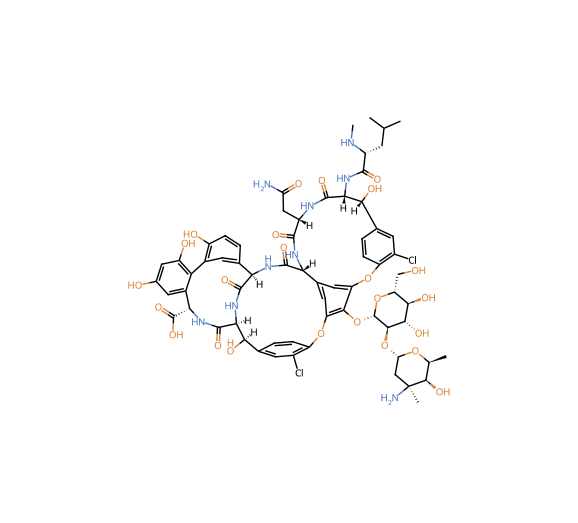
| Molecular/sequence identity | Tricyclic glycopeptide (heptapeptide backbone); C66H75Cl2N9O24 (base); molecular weight 1,449.3 Da (base), 1,485.7 Da (HCl salt). Produced by Amycolatopsis orientalis (formerly Nocardia orientalis). |
| Modifications/form | Hydrochloride salt; Freeze-drying: water is removed by sublimation under reduced pressure, which can improve the stability of peptides and yield a porous dry matrix. Water removal does not sterilize a product, prove its quality, or define how it should later be handled. 定义来源: Lyophilization, formulation, and stability primer · 术语表 powder for Administered into a vein. 定义来源: Neutral gloss; usage context: Routes, devices, and absorption primer · 术语表 infusion after The product-specific pharmaceutical process by which a lyophilized (freeze-dried) solid returns to a liquid dispersion. It is not evidence that the resulting material is suitable for administration. 定义来源: What reconstitution means primer · 术语表; oral capsules and oral solution for C. difficile. Contains a disaccharide moiety and a unique tricyclic structure not found in typical linear peptides. |
| Stable identifiers | The record number of a compound in PubChem, the atlas's primary structure-asset source. A registry record or depiction does not authenticate a commercial sample. 定义来源: Identity and structure assets methodology · 术语表: 14969 (vancomycin); DrugBank: DB00512; ChEBI: CHEBI:28001; CAS: 1404-90-6 (base) |
| Identity caveats | Vancomycin is a glycopeptide (macrocyclic peptide with sugar moieties) rather than a linear peptide or lipopeptide. Distinguish from telavancin, dalbavancin, oritavancin — the "lipoglycopeptides." |
Development and approval status
| Jurisdiction | Status and indication | Product/source | As of |
|---|---|---|---|
| USA (FDA) | Approved (1958) — Administered into a vein. 定义来源: Neutral gloss; usage context: Routes, devices, and absorption primer · 术语表: septicemia, endocarditis, skin/bone/LRT infections (MRSA); Oral: C. difficile and staphylococcal enterocolitis | Multiple generic manufacturers; Vancocin | 1958 (original NDA) |
| EU (EMA) | Approved — same indications | Multiple products | National approvals |
| WHO | Listed on WHO Essential Medicines List | Current |
- UNITED STATES
- USA (FDA): Approved (1958) — IV: septicemia, endocarditis, skin/bone/LRT infections (MRSA); Oral: C. difficile and staphylococcal enterocolitis
- EU/EEA
- EU (EMA): Approved — same indications
- UNITED KINGDOM
- No UNITED KINGDOM row is present in the source status table
- OTHER DOCUMENTED
- WHO: Listed on WHO Essential Medicines List
Sport status: WADA status: not prohibited. No US federal CSA scheduling was identified as of 2026-08-06; state law and other jurisdictions were not assessed. Generic and formulation availability is product- and jurisdiction-specific.
Mechanism and pharmacology
Vancomycin inhibits bacterial cell wall biosynthesis by binding with high affinity to the D-alanyl-D-alanine (D-Ala-D-Ala) terminus of the lipid II–linked peptidoglycan precursor, preventing transpeptidation (cross-linking) and transglycosylation (polymerization). It also alters bacterial cell membrane permeability and RNA synthesis. Bactericidal against most Gram-positive organisms.
How a substance is absorbed, distributed, metabolized, and eliminated by the body; atlas pages report pharmacokinetic data such as half-life, metabolism, and clearance. 定义来源: Neutral gloss; usage context: Routes, devices, and absorption primer · 术语表: Administered into a vein. 定义来源: Neutral gloss; usage context: Routes, devices, and absorption primer · 术语表 administration; poor oral absorption (oral use limited to GI infections); The time for the amount of a substance in the body to fall by half. 定义来源: Neutral gloss; usage context: Routes, devices, and absorption primer · 术语表 ~4-8 h (normal renal); >90% excreted unchanged in urine; Vd 0.4-1 L/kg; 30-55% protein-bound. AUC24/MIC is the best PK/PD correlate for efficacy.
Resistance mechanisms
VanA: high-level vancomycin resistance (VRE, VRSA) — D-Ala-D-Ala replaced by D-Ala-D-Lac (vancomycin affinity reduced ~1000-fold).
VanB: moderate-level resistance (inducible; D-Ala-D-Lac, still susceptible to teicoplanin).
VanC: intrinsic, constitutively expressed low-level resistance (D-Ala-D-Ser). Characteristic of E. gallinarum and E. casseliflavus.
VISA/hVISA: vancomycin-intermediate S. aureus (MIC 4-8 mcg/mL) due to cell wall thickening.
VRSA: vancomycin-resistant S. aureus (MIC ≥16 mcg/mL) — rare, VanA acquisition.
Evidence by claim
| Claim/indication | Stage | Grade | Best human evidence | Main result | Important limitations |
|---|---|---|---|---|---|
| MRSA bacteremia | Approved | A | Multiple A study in which participants are assigned to the study material or a comparator by chance. 定义来源: Neutral gloss; usage context: Evidence grading methodology · 术语表 and meta-analyses; vancomycin is the historical reference comparator in MRSA trials | Clinical success rates typically 45-65% for MRSA bacteremia | Inferior to daptomycin and ceftaroline in some retrospective analyses at higher MICs (≥1.5 mcg/mL) |
| C. difficile infection | Approved | A | Multiple RCTs (fidaxomicin non-inferiority trials; vancomycin as active comparator) | Clinical cure 81-97% for initial episode | Oral metronidazole no longer first-line (superiority of vancomycin in severe CDI per IDSA/SHEA guidelines) |
| MRSA pneumonia | Approved | A | RCTs and retrospective cohorts | Clinical response 50-75% | Debate around optimal dosing (AUC-guided) to reach lung penetration targets |
Text alternative for the claim-evidence diagram. Each grade is defined below:
- A — Established for a specific labeled use
- 3 claims: MRSA bacteremia; C. difficile infection; MRSA pneumonia
- B — Moderate human evidence
- 0 claims
- C — Preliminary human evidence
- 0 claims
- D — Preclinical only
- 0 claims
- E — Anecdotal/marketing claim
- 0 claims
- X — Evidence contradicts or does not support the claim
- 0 claims
Key studies
| Study | Design/population | Exposure studied | Endpoints and result | Limitations |
|---|---|---|---|---|
| Fowler et al. 2006 (daptomycin vs vancomycin/nafcillin) | Phase 3 A study in which participants are assigned to the study material or a comparator by chance. 定义来源: Neutral gloss; usage context: Evidence grading methodology · 术语表; N=246; S. aureus bacteremia | Vancomycin 1 g Administered into a vein. 定义来源: Neutral gloss; usage context: Routes, devices, and absorption primer · 术语表 q12h (adjusted) vs daptomycin 6 mg/kg IV QD | Success 41.8% vs 44.2% (non-inferior) | Small; vancomycin arm included gentamicin |
| Johnson et al. 2014 (fidaxomicin vs vancomycin for CDI) | Phase 3 RCT; N=629 | Vancomycin 125 mg PO QID vs fidaxomicin 200 mg PO BID × 10 d | Cure rates: vancomycin 81.7% vs fidaxomicin 88.2% | Vancomycin efficacy consistent with historical data |
Dose and administration evidence
Approved labeled regimen
The label summary below is product-, indication-, and jurisdiction-specific; consult the full current label and a licensed clinician/pharmacist.
Administered into a vein. 定义来源: Neutral gloss; usage context: Routes, devices, and absorption primer · 术语表 dosing (normal renal function): Adults — 2 g/day divided as 500 mg q6h or 1 g q12h. Pediatric (1 mo+): 10 mg/kg q6h. Neonates: 15 mg/kg initially, then 10 mg/kg q12h (first week of life) or q8h (thereafter). Infuse over ≥60 min. Oral (C. difficile): 125 mg PO QID × 10 d. Staphylococcal enterocolitis: 500 mg to 2 g/day PO in 3-4 divided doses × 7-10 d. Dose in renal impairment: reduce based on renal function; TDM strongly recommended.
What is not established
Optimal dosing strategy (trough-based historically; evolving to AUC24/MIC 400-600).
Vancomycin as monotherapy for enterococcal endocarditis (requires aminoglycoside combination per label).
Safety
Established label risks
Nephrotoxicity (especially with prolonged courses, high troughs, concomitant nephrotoxins).
Ototoxicity (rare but can be irreversible; more common with aminoglycoside combination).
Infusion-related reactions: "Red man syndrome" (histamine release from rapid infusion) — flushing, rash, hypotension. Prevented by slower infusion and pre-treatment with antihistamines.
Infusion-site phlebitis/inflammation.
Neutropenia (rare, typically after prolonged use).
Human-study signals
Vancomycin is among the most commonly used hospital antibiotics worldwide. Safety database is large but post-market in nature (lack of modern pre-market clinical trial-based safety characterization).
Unknowns and product-quality risks
MIC creep and the clinical significance of MIC ≥1.5-2 mcg/mL.
Optimal dosing in obese patients, burn patients, critically ill patients.
Compatibility issues (must not mix with many other drugs).
Interactions and special populations
Increased nephrotoxicity risk with aminoglycosides, contrast dye, amphotericin B, cyclosporine, tacrolimus. No CYP metabolism. Renal impairment: dose reduction essential. Elderly: age-related renal decline increases accumulation risk.
Regulatory, compounding, and sport notes
The World Anti-Doping Agency; its Prohibited List classifies many peptides as prohibited substances in sport. 定义来源: WADA and sport regulation brief · 术语表 status: not prohibited. No US federal CSA scheduling was identified as of 2026-08-06; state law and other jurisdictions were not assessed. Generic and formulation availability is product- and jurisdiction-specific.
Vancomycin is a glycopeptide antibiotic — not a simple linear peptide. It is classified as a peptide-derived drug for the purposes of this atlas.
Evidence gaps
Optimal AUC24/MIC target for non-MRSA Gram-positive infections.
Comparative effectiveness of vancomycin vs newer agents (ceftaroline, dalbavancin, oritavancin) for MRSA bacteremia.
Better biomarkers for vancomycin-associated nephrotoxicity beyond serum creatinine.
Vancomycin loading doses in critically ill patients.
Search notes
Databases and registries: FDA label (accessdata.fda.gov), DailyMed, PubMed, IDSA guidelines
Search terms: vancomycin, glycopeptide, MRSA, C. difficile, VRE, therapeutic drug monitoring, nephrotoxicity
Last searched: 2026-08-06
Inclusion emphasis: FDA labels, IDSA/SHEA guidelines, landmark clinical trials
Sources
FDA prescribing information: Vancomycin hydrochloride for injection. Available at: https://www.accessdata.fda.gov/drugsatfda_docs/label/2022/209481s016lbl.pdf (accessed 2026-08-06).
FDA prescribing information: Vancomycin injection. Available at: https://www.accessdata.fda.gov/drugsatfda_docs/label/2021/213895s000lbl.pdf (accessed 2026-08-06).
DailyMed: Vancomycin hydrochloride. Available at: https://dailymed.nlm.nih.gov/dailymed/drugInfo.cfm?setid=99e523d8-9bde-43cb-8434-497015e5dcbd (accessed 2026-08-06).
Johnson S, et al. Fidaxomicin versus vancomycin for Clostridium difficile infection: meta-analysis of pivotal randomized controlled trials. Clin Infect Dis. 2014;58(6):e84-92. DOI: 10.1093/cid/cit746.
Liu C, et al. Clinical practice guidelines by the Infectious Diseases Society of America for the treatment of methicillin-resistant Staphylococcus aureus infections in adults and children: executive summary. Clin Infect Dis. 2011;52(3):285-92. DOI: 10.1093/cid/cir034.