Research synthesis only; not medical advice. The product-specific pharmaceutical process by which a lyophilized (freeze-dried) solid returns to a liquid dispersion. It is not evidence that the resulting material is suitable for administration. 定义来源: What reconstitution means primer · 术语表 conditions are product-specific and established during development by validated studies. This page explains molecular and formulation science; it does not give a preparation protocol for any product.
Definition
The product-specific pharmaceutical process by which a lyophilized (freeze-dried) solid returns to a liquid dispersion. It is not evidence that the resulting material is suitable for administration. 定义来源: What reconstitution means primer · 术语表 is the product-specific pharmaceutical process by which a Freeze-drying: water is removed by sublimation under reduced pressure, which can improve the stability of peptides and yield a porous dry matrix. Water removal does not sterilize a product, prove its quality, or define how it should later be handled. 定义来源: Lyophilization, formulation, and stability primer · 术语表 (freeze-dried) solid returns to a liquid dispersion. It involves wetting, swelling, dissolution of a porous solid matrix, and sometimes hydration or refolding of the peptide or protein. It is not evidence that the resulting material is suitable for administration.
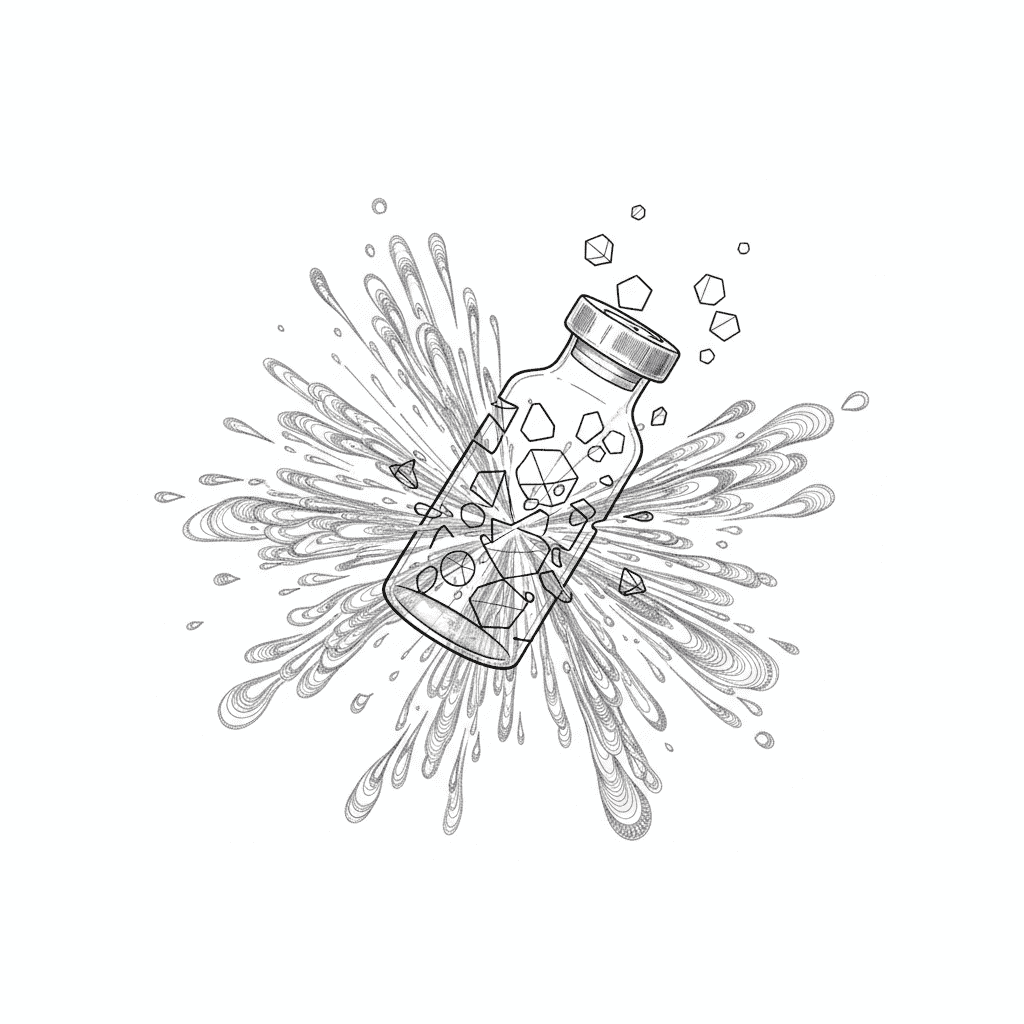
Dry porous cake (peptide and excipients) → liquid contact (wetting and solvent access) → dispersed molecules, where dissolution may compete with aggregation or adsorption. Visible appearance is not verified quality.
Thermodynamics of dissolution
Dissolution is favored when solute–solvent interactions make mixing energetically favorable relative to interactions within the solid. For an ideal solution, ΔG_mix = RT (n₁ ln x₁ + n₂ ln x₂), although peptide solutions often deviate substantially from ideality because of charge, hydrogen bonding, hydrophobic interactions, and excluded-volume effects.
The Nernst–Brunner form of the Noyes–Whitney equation, dC/dt = DA(C_s - C) / (Vh), describes how diffusion coefficient, exposed area, saturation solubility, bulk concentration, volume, and boundary-layer thickness can influence dissolution rate. It is a model, not a product instruction.
Wetting and the lyophile cake
A Freeze-drying: water is removed by sublimation under reduced pressure, which can improve the stability of peptides and yield a porous dry matrix. Water removal does not sterilize a product, prove its quality, or define how it should later be handled. 定义来源: Lyophilization, formulation, and stability primer · 术语表 cake is a porous, amorphous or partly crystalline matrix with a large specific surface area. Liquid contact displaces gas from pores, and wetting behavior depends on contact angle, pore distribution, surface tension, and the formulation’s excipients. Cakes can temporarily float or resist wetting; visible behavior alone does not establish an acceptable product state.
Formulation factors
Role of the diluent
Solvent composition, pH, ionic strength, tonicity, and excipients can affect dissolution and molecular behavior. Official labels may name sterile water, preserved water, saline, or dextrose-based products for a specific presentation, but those materials are not universally interchangeable. Preservatives also have formulation- and population-specific compatibility limits.
Effect of temperature
Temperature changes diffusion, viscosity, solubility, and degradation kinetics. Some peptides become more soluble as temperature rises while others become more aggregation-prone. Only validated product data and current labeling can define a named product’s permitted conditions.
Visible particles and incomplete dispersion
Some cakes form a temporary gel-like phase or show the market-described appearance of “clumping.” Appearance may reveal gross particles or discoloration, but it cannot establish identity, potency, sterility, endotoxin control, or stability. Whether any appearance is acceptable is product-specific.
Aggregation and adsorption at reconstitution
Peptides in liquid may undergo non-covalent or covalent self-association, including hydrophobic or electrostatic association, disulfide scrambling, or cross-linking. Local concentration, interfaces, pH change, metal ions, and container leachables can influence those pathways.
Adsorption is peptide loss to glass, elastomer, polymer, or silicone-associated surfaces. Electrostatic and hydrophobic interactions govern the effect; formulation surfactants can compete for interface sites. These mechanisms are reasons to require product-specific evidence, not a basis for general handling advice.
Peptide in liquid may remain dispersed, adsorb to surfaces, self-associate, or undergo chemical change. Solid, dashed, and dotted lines distinguish the conceptual pathways without ranking them.
Why product-specific instructions are required
Two products containing the same nominal peptide mass can differ in cake porosity, specific surface area, excipient composition, amorphous or crystalline state, residual moisture, container closure, and headspace gas. Those variables can change wetting, dispersion, adsorption, aggregation, and chemical stability.
Lyophilization and stability, product-quality testing, and sterility assurance therefore answer separate questions. For named approved products, follow the authoritative record in the approved-product label index.
Why this is not a how-to guide
This page provides no product-specific liquid, quantity, temperature, timing, tool, sequence, or manipulation. A clear-looking dispersion cannot validate a product, and instructions cannot be generalized between formulations.
Sources
Carpenter JF, Pikal MJ, Chang BS, Randolph TW. Rational design of stable lyophilized protein formulations: some practical advice. Pharm Res. 1997;14(8):969–975. https://doi.org/10.1023/a:1012180707283
USP General Chapter
<1151>Pharmaceutical Dosage Forms. USP–NF. Rockville, MD: United States Pharmacopeia; 2026.FDA. Guidance for Industry: Container and Closure System Integrity Testing in Lieu of Sterility Testing as a Component of the Stability Protocol for Sterile Products. 2008. https://www.fda.gov/regulatory-information/search-fda-guidance-documents
Shire SJ. Formulation and manufacturability of biologics. Curr Opin Biotechnol. 2009;20(6):708–714. https://doi.org/10.1016/j.copbio.2009.10.006
Rathore N, Rajan RS. Current perspectives on stability of protein drug products during formulation, fill and finish operations. Biotechnol Prog. 2008;24(3):504–514. https://doi.org/10.1021/bp070462h
Wang W. Protein aggregation and its inhibition in biopharmaceutics. Int J Pharm. 2005;289(1–2):1–30. https://doi.org/10.1016/j.ijpharm.2004.11.014