Bottom line
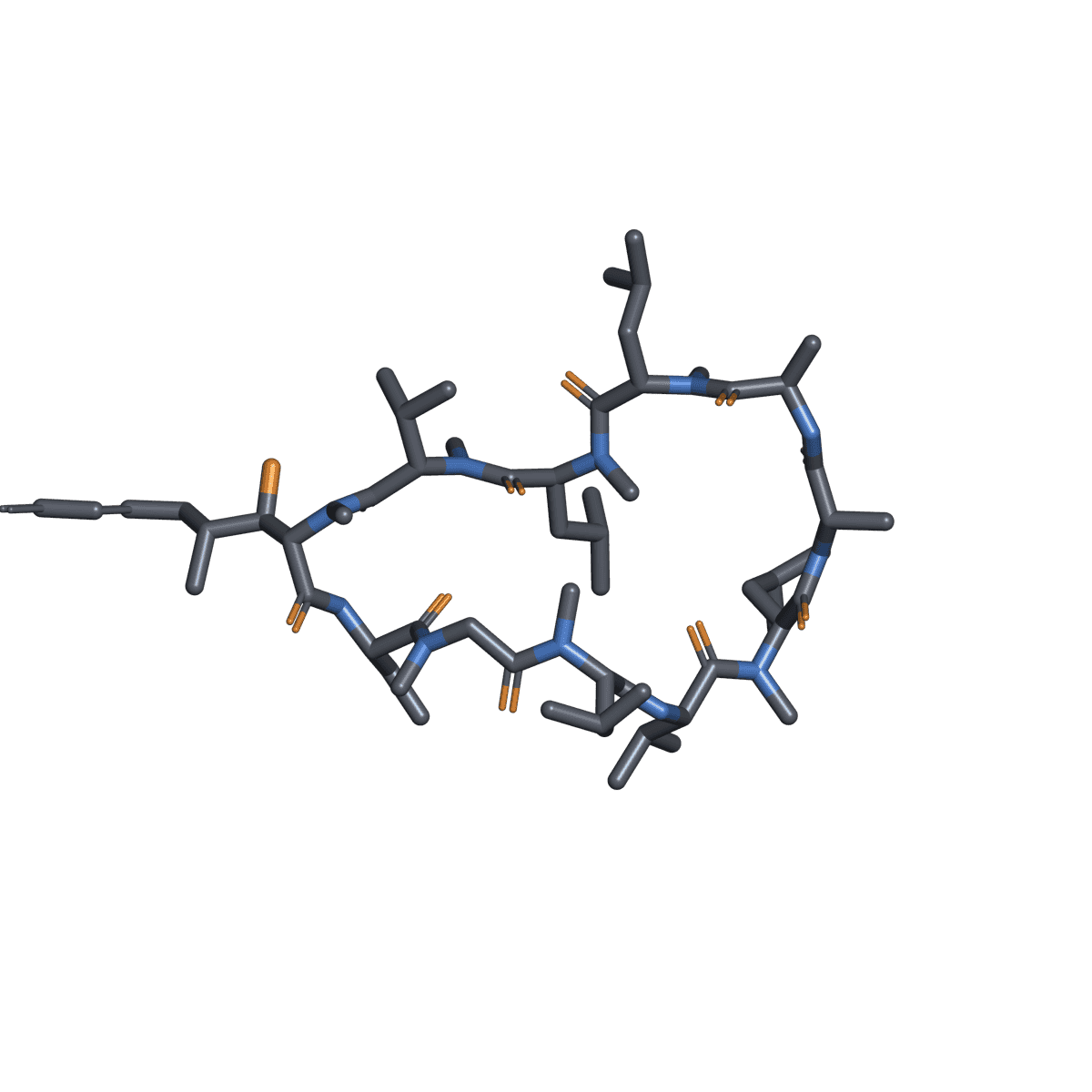
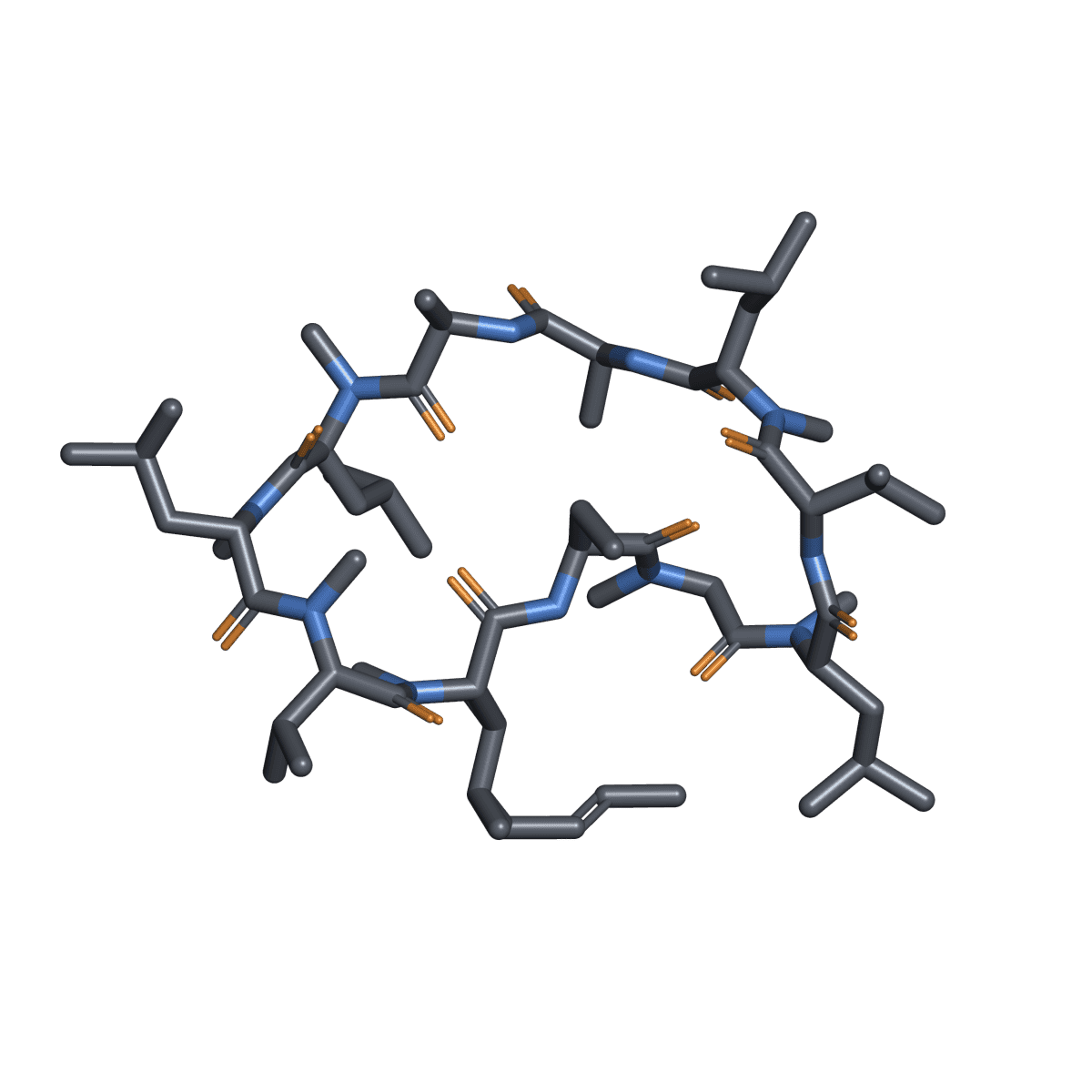
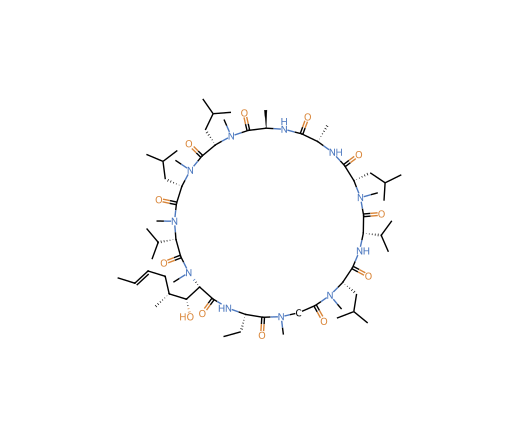
Cyclosporine (cyclosporin A) is a lipophilic cyclic peptide of 11 amino acids isolated from the fungus Tolypocladium inflatum. It is a potent calcineurin inhibitor that suppresses T-cell activation. First approved by the FDA in 1983 for transplant rejection prophylaxis, it has also been approved for rheumatoid arthritis, severe psoriasis, and as an ophthalmic emulsion for dry eye disease. It is listed on the WHO Model List of Essential Medicines.
Identity and composition
| Field | Verified information |
|---|---|
| Preferred name | Cyclosporine |
| Key aliases | Cyclosporin A, Ciclosporin, CsA, Sandimmune, Neoral, Restasis |
| Molecular/sequence identity | Cyclic peptide of 11 amino acids: (4R)-4-((E)-2-butenyl)-4,N-dimethyl-L-threonyl-L-aminobutyryl-N-methylglycyl-N-methyl-L-leucyl-L-valyl-N-methyl-L-leucyl-L-alanyl-D-alanyl-N-methyl-L-leucyl-N-methyl-L-leucyl-N-methyl-L-valyl; sequence is cyclic via amide bonds |
| Modifications/form | Homodetic cyclic peptide (no disulfide bridges); several non-standard amino acids including (4R)-4-((E)-2-butenyl)-4,N-dimethyl-L-threonine (MeBmt); highly lipophilic |
| Stable identifiers | CAS 59865-13-3; The record number of a compound in PubChem, the atlas's primary structure-asset source. A registry record or depiction does not authenticate a commercial sample. Fonte da definição: Identity and structure assets methodology · Glossário 5284373; DrugBank DB00091; UNII 83HN0GTJ6D; ChEBI: 4031 |
| Identity caveats | Multiple cyclosporine analogs exist (A, B, C, D, G); "cyclosporine" refers specifically to cyclosporin A |
Development and approval status
| Jurisdiction | Status and indication | Product/source | As of |
|---|---|---|---|
| US (FDA) | Transplant rejection prophylaxis (kidney, liver, heart) | Sandimmune (original), Neoral (modified) | 2026-08-06 |
| US (FDA) | Rheumatoid arthritis (second-line) | Neoral | 2026-08-06 |
| US (FDA) | Severe recalcitrant plaque psoriasis | Neoral | 2026-08-06 |
| US (FDA) | Dry eye disease (keratoconjunctivitis sicca) | Restasis (ophthalmic emulsion 0.05%) | 2026-08-06 |
| WHO | Essential Medicine (transplant rejection) | Various formulations | 2026-08-06 |
- UNITED STATES
- US (FDA): Transplant rejection prophylaxis (kidney, liver, heart); US (FDA): Rheumatoid arthritis (second-line); US (FDA): Severe recalcitrant plaque psoriasis; US (FDA): Dry eye disease (keratoconjunctivitis sicca)
- EU/EEA
- No EU/EEA row is present in the source status table
- UNITED KINGDOM
- No UNITED KINGDOM row is present in the source status table
- OTHER DOCUMENTED
- WHO: Essential Medicine (transplant rejection)
Sport status: WADA: not prohibited; used in veterinary medicine for canine atopic dermatitis.
Mechanism and pharmacology
Cyclosporine forms a complex with cyclophilin A, which then binds to and inhibits calcineurin, a calcium/calmodulin-dependent serine/threonine phosphatase. Inhibition of calcineurin prevents dephosphorylation of nuclear factor of activated T cells (NF-AT), blocking transcription of IL-2 and other T-cell cytokines. This results in specific immunosuppression of T-lymphocyte activation.
Evidence by claim
| Claim/indication | Stage | Grade | Best human evidence | Main result | Important limitations |
|---|---|---|---|---|---|
| Transplant rejection prophylaxis | Approved | A | Multiple A study in which participants are assigned to the study material or a comparator by chance. Fonte da definição: Neutral gloss; usage context: Evidence grading methodology · Glossário (1980s-1990s) | Reduced acute rejection rates vs azathioprine/steroids | Nephrotoxicity; cardiovascular risk |
| Severe rheumatoid arthritis | Approved | A | RCTs in MTX-refractory patients | Improved ACR20 response vs An inactive comparator used in a controlled study. Fonte da definição: Neutral gloss; usage context: Evidence grading methodology · Glossário | Nephrotoxicity; hypertension |
| Severe plaque psoriasis | Approved | A | Placebo-controlled RCTs | PASI improvement, clearance in responders | Rebound on withdrawal; long-term nephrotoxicity |
| Dry eye disease (ophthalmic) | Approved | A | RCTs (N=~1200) | Increased Schirmer tear test; reduced OSDI | Modest effect size |
- AGrau A: Estabelecido para um uso rotulado específico
- BGrau B: Evidência humana moderada
- CGrau C: Evidência humana preliminar
- DGrau D: Apenas pré-clínico
- EGrau E: Alegação anedótica/de marketing
- XGrau X: A evidência contradiz ou não apoia a alegação
Text alternative for the claim-evidence diagram. Each grade is defined below:
- A — Established for a specific labeled use
- 4 claims: Transplant rejection prophylaxis; Severe rheumatoid arthritis; Severe plaque psoriasis; Dry eye disease (ophthalmic)
- B — Moderate human evidence
- 0 claims
- C — Preliminary human evidence
- 0 claims
- D — Preclinical only
- 0 claims
- E — Anecdotal/marketing claim
- 0 claims
- X — Evidence contradicts or does not support the claim
- 0 claims
Key studies
| Study | Design/population | Exposure studied | Endpoints and result | Limitations |
|---|---|---|---|---|
| Canadian Multicentre Transplant Study (1983) | A study in which participants are assigned to the study material or a comparator by chance. Fonte da definição: Neutral gloss; usage context: Evidence grading methodology · Glossário, cadaveric renal transplant | CsA + prednisone vs azathioprine + prednisone | 1-year graft survival 80% vs 64% | Early cyclosporine era; modern protocols differ |
| AURORA-1 (voclosporin context) | Phase 3, LN | See voclosporin monograph | N/A | N/A |
Dose and administration evidence
Approved labeled regimen
The label summary below is product-, indication-, and jurisdiction-specific; consult the full current label and a licensed clinician/pharmacist. Sandimmune and Neoral are not bioequivalent and cannot be interchanged without physician supervision and monitoring.
Neoral (modified cyclosporine, microemulsion): Kidney transplant — 9 ± 3 mg/kg/day divided BID; Liver transplant — 8-12 mg/kg/day divided BID; Heart transplant — 7-10 mg/kg/day divided BID. Rheumatoid arthritis — 2.5 mg/kg/day divided BID, titrated up to 4 mg/kg/day. Psoriasis — 2.5 mg/kg/day divided BID, titrated up to 4 mg/kg/day.
Sandimmune (non-modified cyclosporine): Kidney transplant — 15 ± 5 mg/kg/day divided BID; Liver transplant — 15 ± 8.5 mg/kg/day divided BID. Significantly lower and more variable The fraction of an administered amount that reaches systemic circulation; for the intravenous route the atlas notes bioavailability is defined as complete. Fonte da definição: Neutral gloss; usage context: Routes, devices, and absorption primer · Glossário than Neoral.
Restasis (ophthalmic emulsion 0.05%): 1 drop BID in each eye, 12 hours apart. Vevye (cyclosporine ophthalmic solution 0.1%): 1 drop BID in each eye.
Therapeutic drug monitoring by trough whole-blood concentration is mandatory for oral formulations; target range varies by indication, transplant type, and time post-transplant.
Studied regimens (not recommendations)
Numerous protocols for off-label indications have been studied. Refer to trial registries for specific studies.
What is not established
No established or recommended human dose for cosmetic or non-approved indications.
Safety
Established label risks
Boxed warning (Neoral):
Only physicians experienced in immunosuppressive therapy for the indicated disease should prescribe Neoral.
Increases susceptibility to infection and development of neoplasia, including lymphoma and other malignancies.
Neoral and Sandimmune are not bioequivalent and cannot be used interchangeably without physician supervision and blood-concentration monitoring.
Cyclosporine blood concentrations must be monitored in transplant and rheumatoid arthritis patients to avoid toxicity.
Additional psoriasis boxed warning:
Patients previously treated with PUVA (and to a lesser extent methotrexate, other immunosuppressives, UVB, coal tar, or radiation therapy) are at increased risk of developing skin malignancies when taking Neoral.
Cyclosporine can cause systemic hypertension and nephrotoxicity; risk increases with dose and duration.
Other major warnings:
Nephrotoxicity (dose-dependent, potentially irreversible).
Hypertension.
Neurotoxicity: tremor, headache, seizures.
Increased risk of infections and lymphoproliferative disorders.
Hepatotoxicity, hyperkalemia, hypomagnesemia.
Gingival hyperplasia, hirsutism.
Anaphylaxis (Administered into a vein. Fonte da definição: Neutral gloss; usage context: Routes, devices, and absorption primer · Glossário formulation).
Ophthalmic: ocular burning.
Contraindications — Rheumatoid arthritis: Abnormal renal function, uncontrolled hypertension, or malignancies. Contraindications — Psoriasis: Concomitant PUVA or UVB therapy, methotrexate or other immunosuppressive agents, coal tar or radiation therapy; abnormal renal function, uncontrolled hypertension, or malignancies.
Human-study signals
Additional risks from long-term use: increased skin cancer risk, particularly in transplant recipients.
Unknowns and product-quality risks
Generic formulations may not be bioequivalent; therapeutic drug monitoring required.
Interactions and special populations
CYP3A4 substrate: numerous drug-drug interactions.
P-glycoprotein interactions.
Grapefruit juice increases exposure.
Pregnancy Category C; excreted in breast milk.
Dose adjustment required for hepatic impairment.
Regulatory, compounding, and sport notes
FDA and EMA approved prescription drug.
The World Anti-Doping Agency; its Prohibited List classifies many peptides as prohibited substances in sport. Fonte da definição: WADA and sport regulation brief · Glossário: not prohibited; used in veterinary medicine for canine atopic dermatitis.
Veterinary formulations (Atopica, Modulis for Cats) are not interchangeable with human formulations.
Evidence gaps
Optimal trough concentration ranges in modern combination therapy.
Long-term safety of topical ophthalmic use beyond 3 years.
Search notes
Databases and registries: PubMed, FDA label, DailyMed, DrugBank, PubChem
Search terms: "cyclosporine", "cyclosporin A", "ciclosporin"
Last searched: 2026-08-06
Inclusion emphasis: FDA labels, pivotal trials, WHO EML
Sources
PubChem. Cyclosporin A (CID 5284373). https://pubchem.ncbi.nlm.nih.gov/compound/5284373
FDA/DailyMed. Neoral prescribing information. https://dailymed.nlm.nih.gov/dailymed/drugInfo.cfm?setid=94461af3-11f1-4670-95d4-2965b9538ae3
FDA/DailyMed. Restasis prescribing information. https://dailymed.nlm.nih.gov/dailymed/drugInfo.cfm?setid=8e24af2b-bc1c-4849-94f2-6df950cdca89
DrugBank. Cyclosporine (DB00091). https://go.drugbank.com/
StatPearls. Cyclosporine. https://www.ncbi.nlm.nih.gov/books/NBK482450/