Bottom line
Desirudin is a recombinant hirudin — a 65-amino-acid direct thrombin inhibitor identical to natural hirudin except for desulfation of Tyr-63. It was approved for DVT prophylaxis after elective hip replacement surgery based on phase 3 trials showing superiority to unfractionated heparin and non-inferiority to enoxaparin. Administered into the tissue layer under the skin. Definition source: Neutral gloss; usage context: Routes, devices, and absorption primer · Glossary administration twice daily. All marketing authorizations have been withdrawn; it is no longer commercially available (US discontinuation; EU Revasc withdrawal 2014).
Identity and composition
| Field | Verified information |
|---|---|
| Preferred name | Desirudin |
| Key aliases | Iprivask, Revasc, recombinant hirudin (rHV1), CGP 39393 |
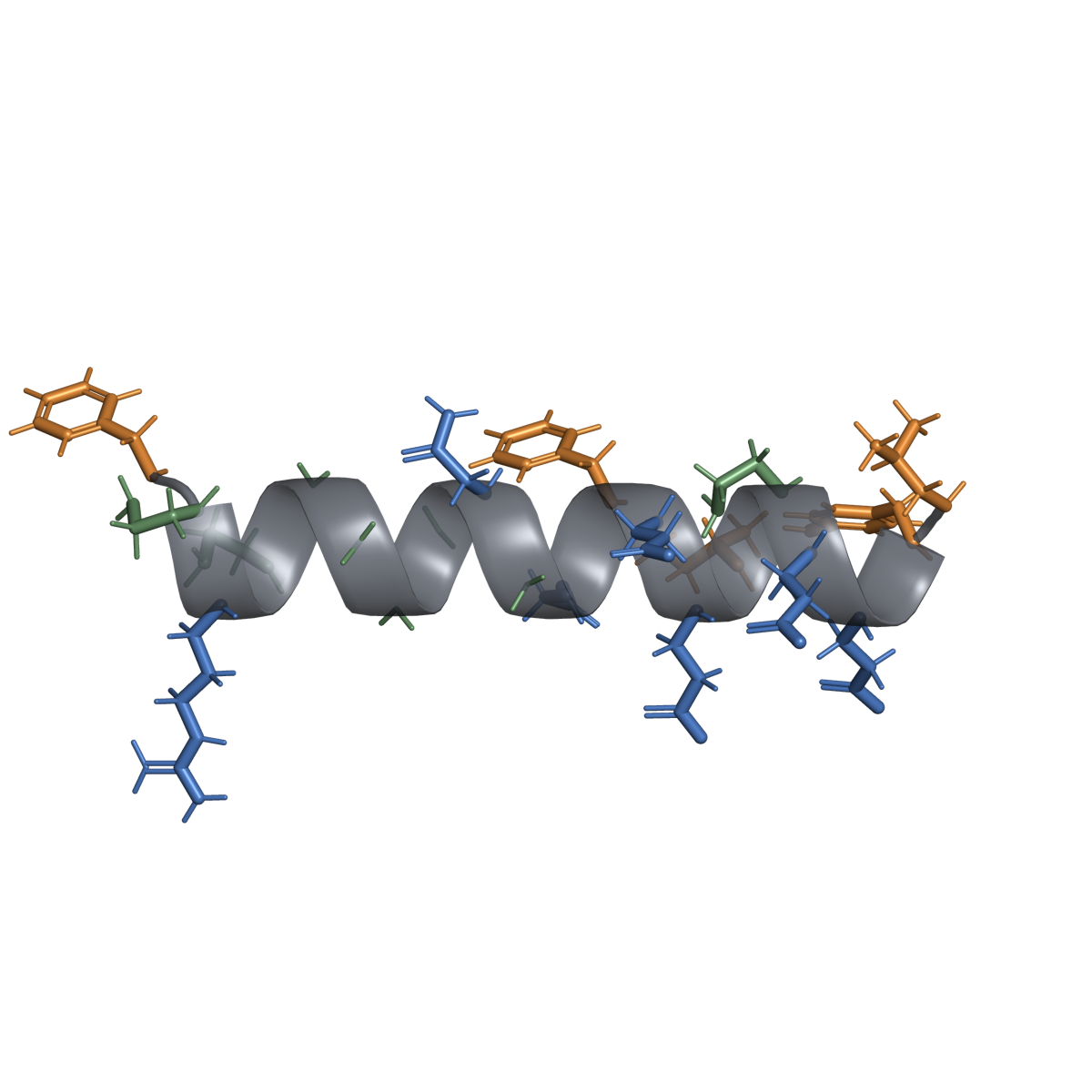
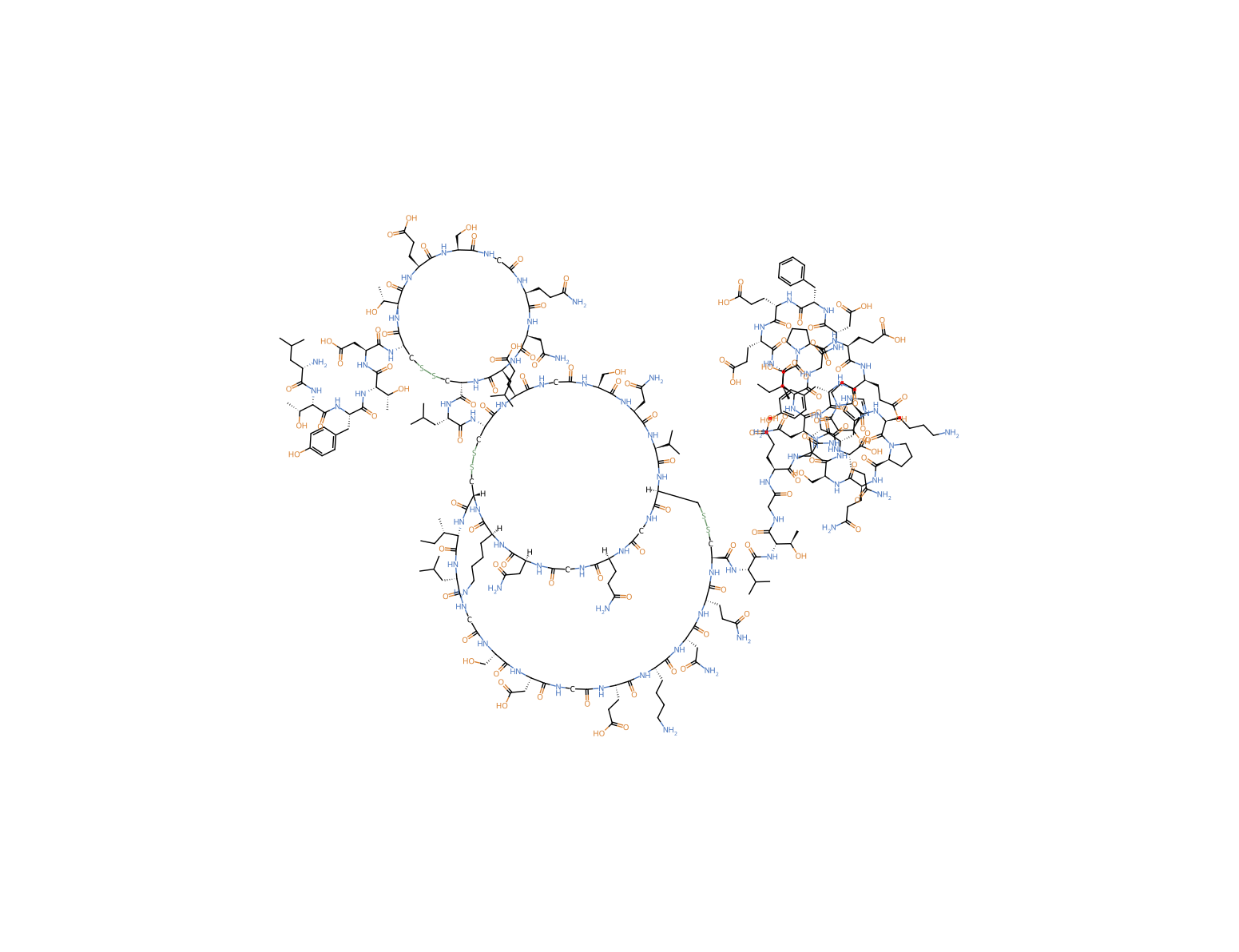
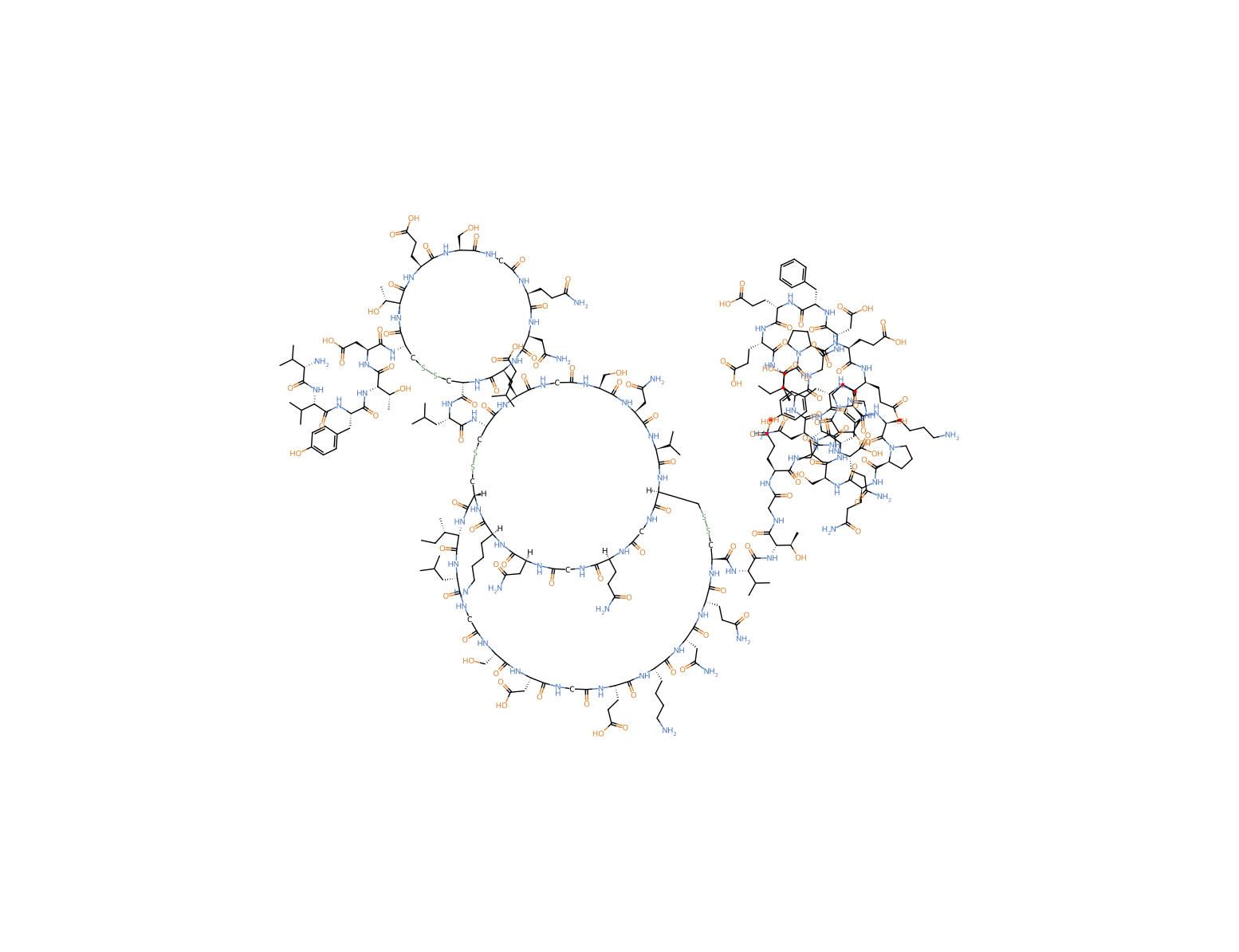
| Molecular/sequence identity | 65-amino-acid desulfatohirudin HV1; 3 disulfide bridges (Cys6-Cys14, Cys16-Cys28, Cys22-Cys39); differs from sulfated natural HV1 by lack of the sulfate group on Tyr-63. Sequence: Val-Val-Tyr-Thr-Asp-Cys-Thr-Glu-Ser-Gly-Gln-Asn-Leu-Cys-Leu-Cys-Glu-Gly-Ser-Asn-Val-Cys-Gly-Gln-Gly-Asn-Lys-Cys-Ile-Leu-Gly-Ser-Asp-Gly-Glu-Lys-Asn-Gln-Cys-Val-Thr-Gly-Glu-Gly-Thr-Pro-Lys-Pro-Gln-Ser-His-Asn-Asp-Gly-Asp-Phe-Glu-Glu-Ile-Pro-Glu-Glu-Tyr-Leu-Gln |
| Modifications/form | Recombinant, expressed in Saccharomyces cerevisiae; Freeze-drying: water is removed by sublimation under reduced pressure, which can improve the stability of peptides and yield a porous dry matrix. Water removal does not sterilize a product, prove its quality, or define how it should later be handled. Definition source: Lyophilization, formulation, and stability primer · Glossary powder for Administered into the tissue layer under the skin. Definition source: Neutral gloss; usage context: Routes, devices, and absorption primer · Glossary injection after The product-specific pharmaceutical process by which a lyophilized (freeze-dried) solid returns to a liquid dispersion. It is not evidence that the resulting material is suitable for administration. Definition source: What reconstitution means primer · Glossary; not sulfated on Tyr-63 |
| Stable identifiers | The record number of a compound in PubChem, the atlas's primary structure-asset source. A registry record or depiction does not authenticate a commercial sample. Definition source: Identity and structure assets methodology · Glossary: 16129703 (desirudin); DrugBank: DB11095; ChEBI: CHEBI:59207; CAS: 120993-53-5 |
| Identity caveats | Desirudin is expressed in yeast; differs from the natural leech hirudin by the absence of a sulfate group on the tyrosine at position 63 |
Development and approval status
| Jurisdiction | Status and indication | Product/source | As of |
|---|---|---|---|
| USA (FDA) | Approved — DVT prophylaxis in elective hip replacement surgery | Iprivask (Canyon Pharmaceuticals) | 2003 (discontinued) |
| EU (EMA) | Approved 1997; marketing authorization withdrawn 2014 | Revasc (Aventis/Novartis) | 1997–2014 |
| Note | Iprivask (US) was discontinued by the manufacturer for commercial reasons and is no longer marketed. Revasc (EU) marketing authorization was withdrawn at the MAH's request in 2014. Desirudin is not commercially available in the US or EU as of 2026. |
- UNITED STATES
- USA (FDA): Approved — DVT prophylaxis in elective hip replacement surgery
- EU/EEA
- EU (EMA): Approved 1997; marketing authorization withdrawn 2014
- UNITED KINGDOM
- No UNITED KINGDOM row is present in the source status table
- OTHER DOCUMENTED
- Note: Iprivask (US) was discontinued by the manufacturer for commercial reasons and is no longer marketed. Revasc (EU) marketing authorization was withdrawn at the MAH's request in 2014. Desirudin is not commercially available in the US or EU as of 2026.
Sport status: WADA status: desirudin was not identified by exact name in the 2026 Prohibited List. Marketing discontinuation is not itself a classification: S0 depends on whether a current governmental approval for human therapeutic use remains in any jurisdiction. This page does not resolve that global question, so athletes need a current, case-specific determination. No US federal CSA scheduling was identified as of 2026-08-06; state law and other jurisdictions were not assessed. Iprivask US marketing was discontinued; EU authorisation of Revasc was withdrawn on 18 July 2014 at the MAH's request for commercial reasons and was never marketed in any EU country. Desirudin is not commercially available in the US or EU as of 2026. Desirudin preceded bivalirudin as the first available recombinant hirudin analogue.
Mechanism and pharmacology
Desirudin is a highly specific, irreversible (stoichiometric 1:1) direct inhibitor of human thrombin. It binds to both the active (catalytic) site and the fibrinogen-binding exosite (exosite 1) of free and clot-bound thrombin. Unlike heparin, desirudin does not require antithrombin III and is not inhibited by platelet factor 4, making it effective against clot-bound thrombin.
How a substance is absorbed, distributed, metabolized, and eliminated by the body; atlas pages report pharmacokinetic data such as half-life, metabolism, and clearance. Definition source: Neutral gloss; usage context: Routes, devices, and absorption primer · Glossary: Administered into the tissue layer under the skin. Definition source: Neutral gloss; usage context: Routes, devices, and absorption primer · Glossary absorption; The fraction of an administered amount that reaches systemic circulation; for the intravenous route the atlas notes bioavailability is defined as complete. Definition source: Neutral gloss; usage context: Routes, devices, and absorption primer · Glossary ~100%; Tmax 1-2 h; The time for the amount of a substance in the body to fall by half. Definition source: Neutral gloss; usage context: Routes, devices, and absorption primer · Glossary ~2 h; primarily renal excretion (>90% unchanged); accumulates in renal impairment.
Evidence by claim
| Claim/indication | Stage | Grade | Best human evidence | Main result | Important limitations |
|---|---|---|---|---|---|
| DVT prophylaxis — elective hip replacement | Approved | A | Pooled analysis of two phase 3 A study in which participants are assigned to the study material or a comparator by chance. Definition source: Neutral gloss; usage context: Evidence grading methodology · Glossary (N=2,052) comparing desirudin 15 mg Administered into the tissue layer under the skin. Definition source: Neutral gloss; usage context: Routes, devices, and absorption primer · Glossary BID vs enoxaparin 40 mg SC QD or UFH 5000 IU SC TID | Total DVT (venography): desirudin 18.4% vs enoxaparin 25.5% (p=0.001) in one trial; proximal DVT: 2.4% vs 6.8% (p=0.01) | Warfarin not used as comparator; contemporary practice favors DOACs |
- AGrade A: Established for a specific labeled use
- BGrade B: Moderate human evidence
- CGrade C: Preliminary human evidence
- DGrade D: Preclinical only
- EGrade E: Anecdotal/marketing claim
- XGrade X: Evidence contradicts or does not support the claim
Text alternative for the claim-evidence diagram. Each grade is defined below:
- A — Established for a specific labeled use
- 1 claim: DVT prophylaxis — elective hip replacement
- B — Moderate human evidence
- 0 claims
- C — Preliminary human evidence
- 0 claims
- D — Preclinical only
- 0 claims
- E — Anecdotal/marketing claim
- 0 claims
- X — Evidence contradicts or does not support the claim
- 0 claims
Key studies
| Study | Design/population | Exposure studied | Endpoints and result | Limitations |
|---|---|---|---|---|
| Eriksson et al. (1997) | DB, A study in which participants are assigned to the study material or a comparator by chance. Definition source: Neutral gloss; usage context: Evidence grading methodology · Glossary; N=1,119; elective hip replacement | Desirudin 15 mg Administered into the tissue layer under the skin. Definition source: Neutral gloss; usage context: Routes, devices, and absorption primer · Glossary BID vs enoxaparin 40 mg SC QD (both started pre-op) | Total DVT: 18.4% vs 25.5% (p=0.001); proximal DVT: 2.4% vs 6.8% (p=0.01); major bleeding: similar between groups | Mandatory venography at day 8-10; A study in which participants and investigators know what is administered. Definition source: Neutral gloss; usage context: Evidence grading methodology · Glossary extension for bleeding |
| HIP CREP (comparator vs UFH) | DB, RCT; N=933; elective hip replacement | Desirudin 15 mg SC BID vs UFH 5000 IU SC TID | Total DVT: 10.7% vs 24.3% (p<0.001); proximal DVT: 2.7% vs 8.5% (p<0.001) | UFH comparator (not enoxaparin or DOAC) |
Dose and administration evidence
Approved labeled regimen
The label summary below is product-, indication-, and jurisdiction-specific; consult the full current label and a licensed clinician/pharmacist.
Elective hip replacement: 15 mg Administered into the tissue layer under the skin. Definition source: Neutral gloss; usage context: Routes, devices, and absorption primer · Glossary every 12 h. First dose given 5-15 min prior to surgery (but after induction of regional block anesthesia). Continue for 9-12 days. In moderate renal impairment (CrCl 31–60 mL/min): reduce dose by factor of 3 (5 mg SC q12h). In severe renal impairment (CrCl <31 mL/min): reduce dose by factor of 9 (1.7 mg SC q12h). Monitor aPTT and serum creatinine daily in patients with renal impairment.
Studied regimens (not recommendations)
Various dose-ranging studies used 10-20 mg SC BID; the 15 mg BID dose was selected as the optimal balance of efficacy and safety.
What is not established
DVT prophylaxis for knee replacement (not established; phase 3 data limited to hip replacement).
Treatment of established VTE (not labeled).
Use in ACS or PCI (not labeled; bivalirudin used instead for these indications).
Pediatric use.
Safety
Established label risks
Bleeding (most common). Desirudin carries an FDA boxed warning for spinal/epidural hematoma with neuraxial anesthesia — this is appropriate for a subcutaneously administered anticoagulant with prolonged The time for the amount of a substance in the body to fall by half. Definition source: Neutral gloss; usage context: Routes, devices, and absorption primer · Glossary in renal impairment.
Hypersensitivity to hirudins (contraindicated).
Injection-site hematoma.
Renal impairment increases bleeding risk; accumulation in renal impairment extends the half-life substantially.
Human-study signals
Anti-hirudin antibodies: developed in ~44% of treated patients in long-term follow-up; did not appear to affect efficacy or safety in the short DVT-prophylaxis duration, but potential for anaphylaxis with re-exposure.
No HIT (heparin-induced thrombocytopenia) because desirudin is not heparin-like.
Unknowns and product-quality risks
Product has a boxed warning for spinal/epidural hematoma (same class warning as all anticoagulants used with neuraxial procedures).
The product-specific pharmaceutical process by which a lyophilized (freeze-dried) solid returns to a liquid dispersion. It is not evidence that the resulting material is suitable for administration. Definition source: What reconstitution means primer · Glossary solution is stable for 24 h at room temperature; store Freeze-drying: water is removed by sublimation under reduced pressure, which can improve the stability of peptides and yield a porous dry matrix. Water removal does not sterilize a product, prove its quality, or define how it should later be handled. Definition source: Lyophilization, formulation, and stability primer · Glossary powder at 2-25°C.
Interactions and special populations
Increased bleeding with antiplatelet agents, other anticoagulants, NSAIDs. Significant renal accumulation in CrCl <30 mL/min (contraindicated in some labels). No CYP-mediated interactions.
Regulatory, compounding, and sport notes
The World Anti-Doping Agency; its Prohibited List classifies many peptides as prohibited substances in sport. Definition source: WADA and sport regulation brief · Glossary status: desirudin was not identified by exact name in the 2026 Prohibited List. Marketing discontinuation is not itself a classification: WADA Prohibited List class S0 (non-approved substances): pharmacological substances not addressed elsewhere in the list and with no current approval by any governmental regulatory health authority for human therapeutic use. Definition source: WADA and sport regulation brief · Glossary depends on whether a current governmental approval for human therapeutic use remains in any jurisdiction. This page does not resolve that global question, so athletes need a current, case-specific determination. No US federal CSA scheduling was identified as of 2026-08-06; state law and other jurisdictions were not assessed. Iprivask US marketing was discontinued; EU authorisation of Revasc was withdrawn on 18 July 2014 at the MAH's request for commercial reasons and was never marketed in any EU country. Desirudin is not commercially available in the US or EU as of 2026. Desirudin preceded bivalirudin as the first available recombinant hirudin analogue.
Evidence gaps
No contemporary comparative data vs DOACs (rivaroxaban, apixaban, dabigatran, edoxaban) for hip replacement.
Very limited data in renal impairment; no long-term safety database.
Antibody formation risk with repeated intermittent exposure (e.g., bilateral staged hip replacements).
Search notes
Databases and registries: FDA label (accessdata.fda.gov), DailyMed, PubMed, ClinicalTrials.gov
Search terms: desirudin, Iprivask, Revasc, recombinant hirudin, DVT prophylaxis, hip replacement
Last searched: 2026-08-06
Inclusion emphasis: FDA label, phase 3 A study in which participants are assigned to the study material or a comparator by chance. Definition source: Neutral gloss; usage context: Evidence grading methodology · Glossary, systematic reviews
Sources
FDA prescribing information: IPRIVASK (desirudin for injection). Available at: https://www.accessdata.fda.gov/drugsatfda_docs/label/2014/021271s006lbl.pdf (accessed 2026-08-06).
Eriksson BI, et al. A comparison of recombinant hirudin with a low-molecular-weight heparin to prevent thromboembolic complications after total hip replacement. N Engl J Med. 1997;337(19):1329-35. DOI: 10.1056/NEJM199711063371901. https://doi.org/10.1056/NEJM199711063371901
Eriksson BI, et al. Prevention of deep-vein thrombosis after total hip replacement: direct thrombin inhibition with recombinant hirudin, CGP 39393. Lancet. 1996;347(9001):635-9. DOI: 10.1016/S0140-6736(96)91200-3. https://doi.org/10.1016/S0140-6736(96)91200-3
PubChem. Desirudin, CID 16129703. https://pubchem.ncbi.nlm.nih.gov/compound/16129703 (accessed 2026-08-06).
World Anti-Doping Agency. 2026 Prohibited List. https://www.wada-ama.org/sites/default/files/2025-09/2026list_en_final_clean_september_2025.pdf
DrugBank. Desirudin (DB11095). https://go.drugbank.com/drugs/DB11095 (accessed 2026-08-06).