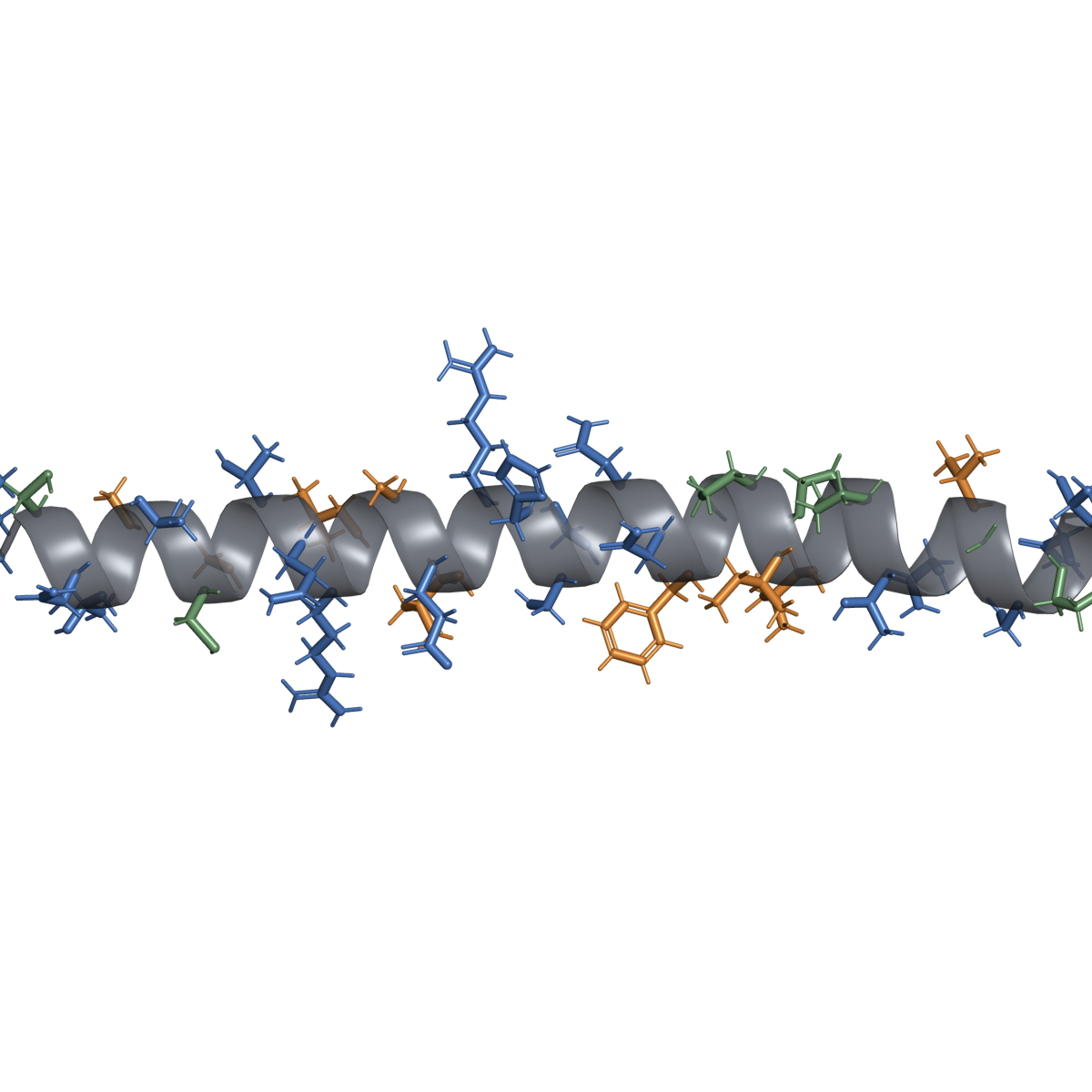
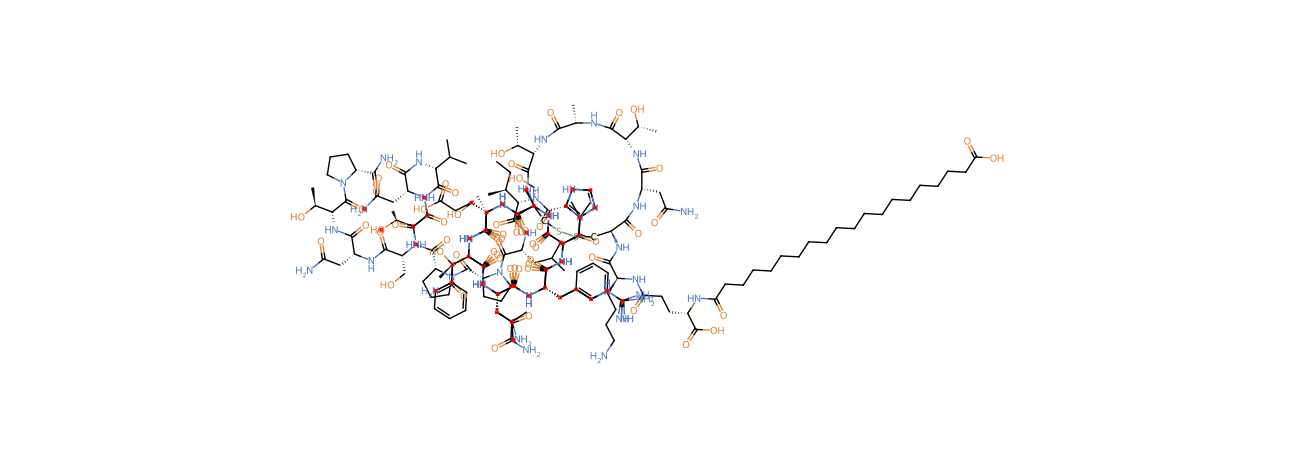
Bottom line
Long-acting acylated amylin analog in Phase 3 development (RENEW program) for obesity. Not FDA- or EMA-approved. Co-formulation with semaglutide (CagriSema) also under investigation. Published Phase 2 data show dose-dependent weight loss, but no established or recommended human dose exists.
Identity and composition
| Field | Verified information |
|---|---|
| Preferred name | Cagrilintide |
| Key aliases | NN9838, ZP4982 |
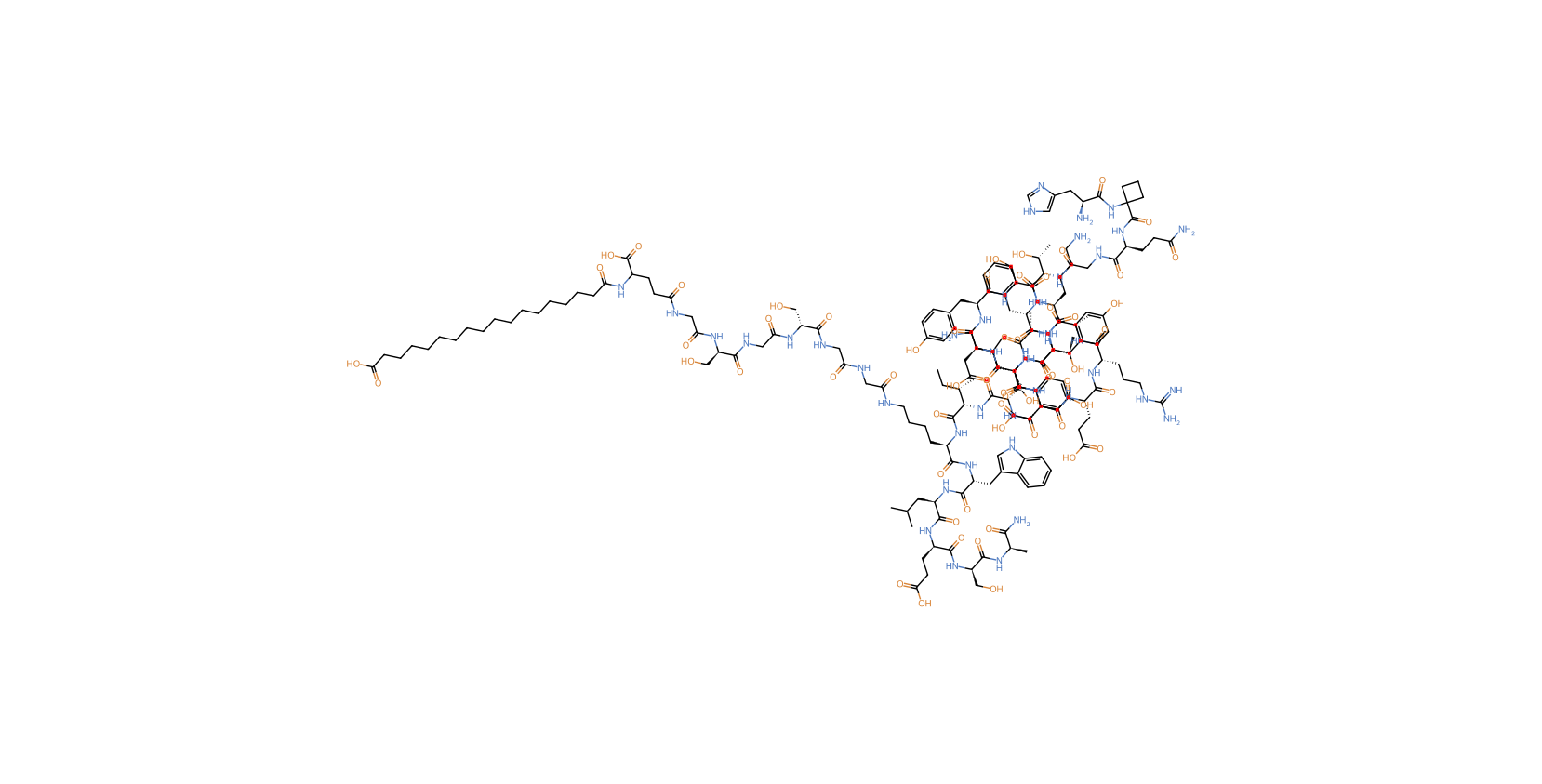
| Molecular/sequence identity | K(eicosanedioyl-gGlu)CNTATCATQRLAELRHSSNNFGPILPPTNVGSNTP-NH2; 37-amino-acid acylated amylin analog |
| Modifications/form | C-terminal amide; N-terminal Lys conjugated to eicosanedioic acid via a gamma-glutamic acid linker |
| Stable identifiers | The record number of a compound in PubChem, the atlas's primary structure-asset source. A registry record or depiction does not authenticate a commercial sample. Fuente de la definición: Identity and structure assets methodology · Glosario: 171397054; CAS 2007557-88-2; WHO ATC not yet assigned |
| Identity caveats | A clinical-stage candidate with scientific or public relevance. Investigation is not approval, and a studied exposure is not a recommendation. Fuente de la definición: Scope and selection methodology · Glosario drug; the reference sequence differs from human amylin at multiple positions and includes a fatty-acid side chain enabling once-weekly dosing. |
Development and approval status
| Jurisdiction | Status and indication | Product/source | As of |
|---|---|---|---|
| US (FDA) | No approved application; Phase 3 ongoing (RENEW 1–3) | NN9838 (Novo Nordisk) | Aug 2026 |
| EU (EMA) | No approved application | NN9838 | Aug 2026 |
| Public development record | No regulatory submission was identified in the public sources reviewed; confidential filings cannot be excluded | — | Aug 2026 |
- UNITED STATES
- US (FDA): No approved application; Phase 3 ongoing (RENEW 1–3)
- EU/EEA
- EU (EMA): No approved application
- UNITED KINGDOM
- No UNITED KINGDOM row is present in the source status table
- OTHER DOCUMENTED
- Public development record: No regulatory submission was identified in the public sources reviewed; confidential filings cannot be excluded
Sport status: WADA: S0 — non-approved pharmacological substance. As an unapproved long-acting amylin analog, it falls under WADA S0 (any pharmacological substance not addressed by other sections of the Prohibited List and not approved by any governmental regulatory authority for human therapeutic use).
Mechanism and pharmacology
Cagrilintide is a long-acting acylated amylin analog that activates the amylin receptor complex (AMY1 and AMY3 subtypes, formed by co-expression of the calcitonin receptor with receptor-activity-modifying proteins) and also binds calcitonin receptors. Amylin receptor agonism delays gastric emptying, suppresses postprandial glucagon secretion, and promotes satiety via area-postrema signaling. The eicosanedioyl-gGlu side chain enables albumin binding and once-weekly Administered into the tissue layer under the skin. Fuente de la definición: Neutral gloss; usage context: Routes, devices, and absorption primer · Glosario dosing.
Evidence by claim
| Claim/indication | Stage | Grade | Best human evidence | Main result | Important limitations |
|---|---|---|---|---|---|
| Weight reduction in overweight/obesity (cagrilintide monotherapy) | Phase 2 | B | 26-week, An inactive comparator used in a controlled study. Fuente de la definición: Neutral gloss; usage context: Evidence grading methodology · Glosario- and active-controlled Phase 2 trial (NCT03856047; n=706; Lancet 2021) | Weight loss 6.0–10.8% (cagrilintide) vs 9.0% (liraglutide 3.0 mg) vs 3.0% (placebo) | Short duration; dose-response plateau unclear below 4.5 mg |
| Weight reduction in obesity + T2D (CagriSema co-formulation) | Phase 2 [1] | B | 32-week dose-finding trial (NCT04982575, n=92) | Up to 15.6% weight loss at highest dose; HbA1c −1.9 to −2.2% | Small sample; co-formulation confounds attribution |
| Weight reduction — Phase 3 REDEFINE 1 sub-analysis (T2D) | Phase 3 | B | 68-week sub-analysis presented Sep 2025 | 11.8% weight loss (vs 2.3% placebo) | Sub-analysis, not primary endpoint; full publication pending |
- AGrado A: Establecido para un uso etiquetado específico
- BGrado B: Evidencia humana moderada
- CGrado C: Evidencia humana preliminar
- DGrado D: Solo preclínico
- EGrado E: Afirmación anecdótica/de marketing
- XGrado X: La evidencia contradice o no respalda la afirmación
Text alternative for the claim-evidence diagram. Each grade is defined below:
- A — Established for a specific labeled use
- 0 claims
- B — Moderate human evidence
- 3 claims: Weight reduction in overweight/obesity (cagrilintide monotherapy); Weight reduction in obesity + T2D (CagriSema co-formulation); Weight reduction — Phase 3 REDEFINE 1 sub-analysis (T2D)
- C — Preliminary human evidence
- 0 claims
- D — Preclinical only
- 0 claims
- E — Anecdotal/marketing claim
- 0 claims
- X — Evidence contradicts or does not support the claim
- 0 claims
Key studies
| Study | Design/population | Exposure studied | Endpoints and result | Limitations |
|---|---|---|---|---|
| Lau et al., Lancet 2021 | 26-wk dose-ranging Phase 2 A study in which participants are assigned to the study material or a comparator by chance. Fuente de la definición: Neutral gloss; usage context: Evidence grading methodology · Glosario (NCT03856047; n=706, adults without diabetes, BMI ≥30 or ≥27 with hypertension/dyslipidaemia) | Cagrilintide 0.3–4.5 mg Administered into the tissue layer under the skin. Fuente de la definición: Neutral gloss; usage context: Routes, devices, and absorption primer · Glosario q1w vs liraglutide 3.0 mg qd or An inactive comparator used in a controlled study. Fuente de la definición: Neutral gloss; usage context: Evidence grading methodology · Glosario | Weight loss 6.0–10.8% (cagrilintide) vs 9.0% (liraglutide) vs 3.0% (placebo) | Short duration; dose-response plateau unclear below 4.5 mg |
| CagriSema Phase 2 (NCT04982575) | 32-wk Phase 2 dose-finding (n=92, overweight/obesity with T2D) [1] | CagriSema (semaglutide 2.4 mg + cagrilintide 2.4 mg) SC q1w | Weight loss up to 15.6%; HbA1c −1.9 to −2.2% | Small sample; co-formulation prevents attribution of effect to individual components |
| REDEFINE 1 sub-analysis (Sep 2025) | 68-wk Phase 3 sub-analysis (T2D subpopulation) | Cagrilintide 2.4 mg SC q1w (+ semaglutide in CagriSema) | 11.8% weight loss vs 2.3% placebo | Not primary endpoint; results from press release pending peer-reviewed publication |
Dose and administration evidence
Approved labeled regimen
Not applicable — no approved application.
Studied regimens (not recommendations)
cagrilintide monotherapy: 0.3, 0.6, 1.2, 2.4, 3.0, 4.5 mg Administered into the tissue layer under the skin. Fuente de la definición: Neutral gloss; usage context: Routes, devices, and absorption primer · Glosario once weekly (Phase 2).
CagriSema: semaglutide 2.4 mg + cagrilintide 2.4 mg SC once weekly (Phase 2 co-formulation).
Titration schedules vary by protocol; published regimens should not be extrapolated to unapproved use.
What is not established
No established or recommended human dose.
Safety
Established label risks
Not applicable — no approved label.
Human-study signals
Gastrointestinal: nausea, vomiting, diarrhea (dose-dependent, highest at 4.5 mg).
Hypoglycemia risk in T2D populations when used with insulin or sulfonylureas.
Unknowns and product-quality risks
Long-term safety, cardiovascular outcomes, and malignancy risk have not been characterized.
Pancreatitis risk, medullary thyroid carcinoma signal (amylin-class concern by analogy to Expansion of the abbreviation used in the monographs: glucagon-like peptide-1 receptor agonist. The atlas does not define the pharmacology of this class; see the monograph for what is documented about a specific compound. Fuente de la definición: Neutral gloss; the abbreviation is printed on the tirzepatide monograph but the atlas does not define the class pharmacology · Glosario class) not ruled out.
Products marketed as "research use only" before approval may differ in purity, potency, and excipients from the phase-appropriate drug substance.
Interactions and special populations
No interaction studies have been published. The effect of renal or hepatic impairment on How a substance is absorbed, distributed, metabolized, and eliminated by the body; atlas pages report pharmacokinetic data such as half-life, metabolism, and clearance. Fuente de la definición: Neutral gloss; usage context: Routes, devices, and absorption primer · Glosario is unknown.
Regulatory, compounding, and sport notes
No marketing authorization was identified in the major regulator databases reviewed. FDA states that cagrilintide cannot be used in compounding under US federal law and is not a component of an FDA-approved drug. Purported “research grade” material is not the sponsor's regulated A clinical-stage candidate with scientific or public relevance. Investigation is not approval, and a studied exposure is not a recommendation. Fuente de la definición: Scope and selection methodology · Glosario product.
The World Anti-Doping Agency; its Prohibited List classifies many peptides as prohibited substances in sport. Fuente de la definición: WADA and sport regulation brief · Glosario: WADA Prohibited List class S0 (non-approved substances): pharmacological substances not addressed elsewhere in the list and with no current approval by any governmental regulatory health authority for human therapeutic use. Fuente de la definición: WADA and sport regulation brief · Glosario — non-approved pharmacological substance. As an unapproved long-acting amylin analog, it falls under WADA S0 (any pharmacological substance not addressed by other sections of the Prohibited List and not approved by any governmental regulatory authority for human therapeutic use).
Evidence gaps
Phase 3 data (RENEW 1–3) not yet fully published.
No long-term CVOT data.
Carcinogenicity and reproductive toxicology data not publicly available.
No head-to-head comparison with Expansion of the abbreviation used in the monographs: glucagon-like peptide-1 receptor agonist. The atlas does not define the pharmacology of this class; see the monograph for what is documented about a specific compound. Fuente de la definición: Neutral gloss; the abbreviation is printed on the tirzepatide monograph but the atlas does not define the class pharmacology · Glosario as monotherapy.
Formulation stability under non-study storage conditions unknown.
Search notes
Databases and registries: ClinicalTrials.gov (NCT numbers pending RENEW program), PubMed, DailyMed, OpenFDAA.
Search terms: "cagrilintide" OR "NN9838" OR "ZP4982" OR "CagriSema".
Last searched: 2026-08-06.
Inclusion emphasis: Primary literature, ClinicalTrials.gov records, press releases from Novo Nordisk verified against registry.
Sources
Lau DCW, et al. Once-weekly cagrilintide for weight management. Lancet. 2021;398(10317):2160–2172. https://doi.org/10.1016/S0140-6736(21)01751-7
Frias JP, et al. CagriSema (semaglutide + cagrilintide) in T2D — Phase 2. ClinicalTrials.gov NCT04982575. https://clinicaltrials.gov/ct2/show/NCT04982575
Novo Nordisk. REDEFINE 1 Phase 3 top-line results press release, September 2025. Verified against ClinicalTrials.gov record.
PubChem CID 171397054 — Cagrilintide. https://pubchem.ncbi.nlm.nih.gov/compound/171397054. Accessed 2026-08-06.
Kruse T, et al. Long-acting amylin analog NN9838 — preclinical characterization. Diabetes. 2022;71(Suppl 1):A348.
ClinicalTrials.gov. Search: cagrilintide. https://clinicaltrials.gov/search?term=cagrilintide. Accessed 2026-08-06.
US Food and Drug Administration. FDA's Concerns with Unapproved GLP-1 Drugs Used for Weight Loss. Updated 2026. https://www.fda.gov/drugs/postmarket-drug-safety-information-patients-and-providers/fdas-concerns-unapproved-glp-1-drugs-used-weight-loss