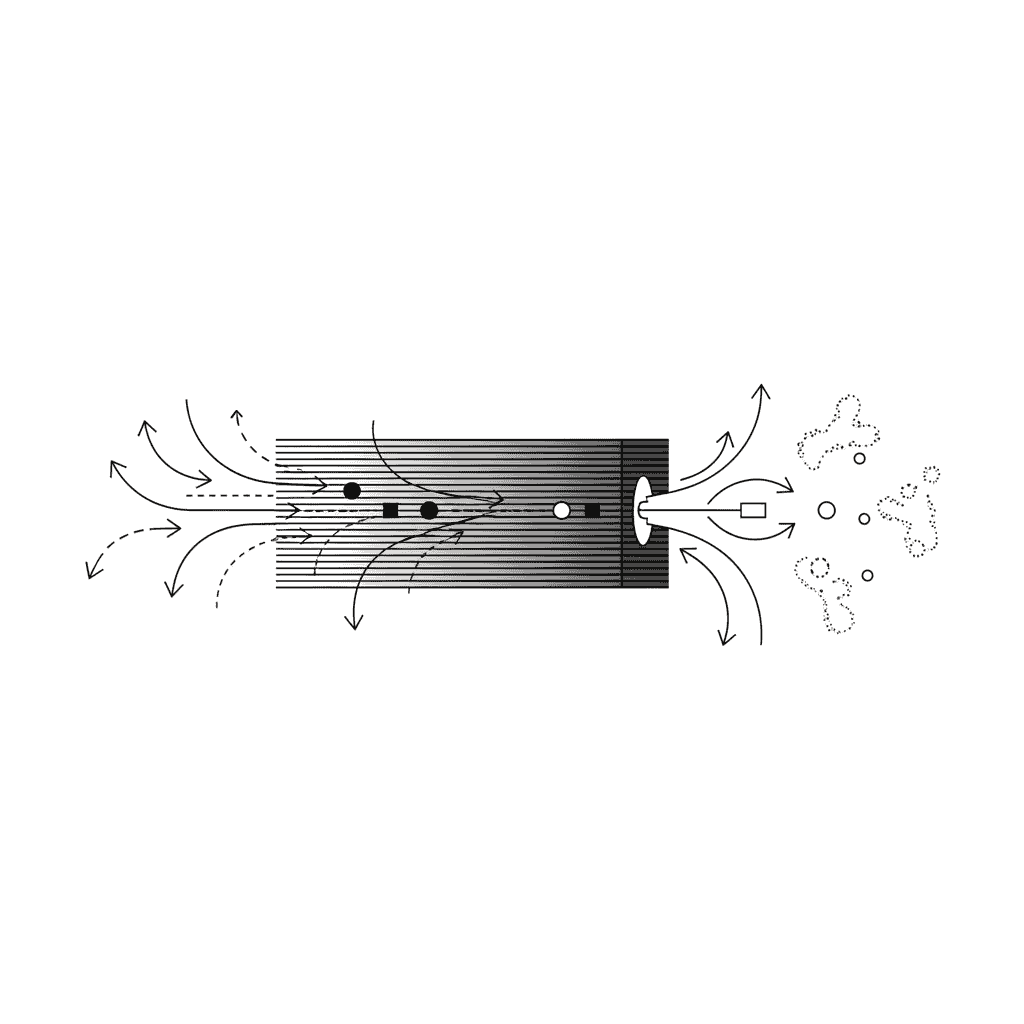
Research synthesis only; not medical advice. Route, device, formulation, and administration technique are product-specific and governed by current approved labeling or an ethics-approved protocol. This page provides no self-administration instructions.
Routes of administration for peptide products
Peptides often have low oral The fraction of an administered amount that reaches systemic circulation; for the intravenous route the atlas notes bioavailability is defined as complete. Fuente de la definición: Neutral gloss; usage context: Routes, devices, and absorption primer · Glosario because proteolysis and poor permeability limit passage across the gastrointestinal epithelium. The relevance of molecular mass, polarity, enzymes, tissue barriers, and transport differs by molecule and formulation.
Administered into the tissue layer under the skin. Fuente de la definición: Neutral gloss; usage context: Routes, devices, and absorption primer · Glosario (SC)
Barrier: Local tissue, extracellular matrix, capillary walls, and sometimes lymphatic transport influence entry into systemic circulation.
Formulation dependency: Viscosity, pH, excipients, molecular size, and any release-controlling system can change the delivery profile.
Evidence caveat: Insulin, Expansion of the abbreviation used in the monographs: glucagon-like peptide-1 receptor agonist. The atlas does not define the pharmacology of this class; see the monograph for what is documented about a specific compound. Fuente de la definición: Neutral gloss; the abbreviation is printed on the tirzepatide monograph but the atlas does not define the class pharmacology · Glosario, and teriparatide provide approved-product examples, but their absorption and label conditions do not transfer to other peptides.
Administered into a muscle. Fuente de la definición: Neutral gloss; usage context: Routes, devices, and absorption primer · Glosario (IM)
Barrier: Muscle tissue and local blood flow influence absorption before systemic circulation.
Formulation dependency: Some approved depot products use formulation-controlled release rather than the route alone to shape exposure.
Evidence caveat: Product, formulation, device, population, and study design determine the observed profile.
Administered into a vein. Fuente de la definición: Neutral gloss; usage context: Routes, devices, and absorption primer · Glosario (IV)
Barrier: The product enters systemic circulation directly, so bioavailability is defined as complete for How a substance is absorbed, distributed, metabolized, and eliminated by the body; atlas pages report pharmacokinetic data such as half-life, metabolism, and clearance. Fuente de la definición: Neutral gloss; usage context: Routes, devices, and absorption primer · Glosario comparison.
Formulation dependency: Compatibility, presentation, and delivery system remain product-specific even though there is no absorption step.
Evidence caveat: Direct circulation does not mean safer or preferable; rapid exposure can change risk.
Intranasal
Barrier: Nasal mucus, mucociliary clearance, enzymatic activity, and epithelial permeability limit systemic entry.
Formulation dependency: Desmopressin and calcitonin are product examples; formulation and device features contribute to their reviewed performance.
Evidence caveat: Low and variable bioavailability reported in literature is not a peptide-wide constant.
Transdermal
Barrier: The stratum corneum strongly limits passive transport of large, hydrophilic molecules.
Formulation dependency: Iontophoresis, microneedle arrays, sonophoresis, and thermal poration are active-delivery research approaches rather than interchangeable routes.
Evidence caveat: No approved transdermal peptide system for hypoparathyroidism is identified here; Yorvipath is a subcutaneous approved product.
Pulmonary
Barrier: Airway deposition, mucus, enzymes, epithelial transport, mucociliary clearance, and macrophage uptake influence systemic exposure.
Formulation dependency: Inhaled-insulin products such as Exubera and Afrezza illustrate how powder engineering and devices form part of the product.
Evidence caveat: Market history and study results for one system do not establish suitability for another peptide.
- SC: subcutaneous tissue; barrier context: tissue + vessel wall; destination: systemic circulation.
- IM: muscle tissue; barrier context: tissue + vessel wall; destination: systemic circulation.
- IV: circulation; barrier context: none drawn; destination: systemic circulation.
- INTRANASAL: nasal surface; barrier context: mucosa + vessel wall; destination: systemic circulation.
- PULMONARY: airway surface; barrier context: epithelium + vessel wall; destination: systemic circulation.
Depot and controlled-release formulations
Release can be shaped by PLGA microspheres, in-situ depot-forming systems, lipid-based carriers, covalent modification such as PEGylation, or fusion to Fc or albumin-binding domains. Leuprolide depot, Eligard, dulaglutide, and related products illustrate different product systems. Exposure duration follows the molecule–formulation–device combination, not a route label alone.
Devices
| Device | Product examples | Delivery-system distinction |
|---|---|---|
| Prefilled syringe | Enoxaparin, teriparatide | Container, presentation, and delivery features are reviewed together |
| Injection pen | Insulin, GLP-1 agonists, somatropin | A product-specific selector, container, and formulation form one system |
| Auto-injector | Epinephrine and selected GLP-1 products | A fixed or configured product presentation includes human-factors validation |
| Infusion pump | Insulin and selected specialist products | Reservoir, control logic, tubing, and formulation compatibility affect delivery |
| Implant | Leuprolide acetate and histrelin acetate | Device placement and removal belong to trained clinical practice |
| Dry-powder inhaler | Inhaled insulin | Powder properties and breath-actuated device performance are linked |
| Needle-free injector | Selected somatropin products | Jet delivery has product- and device-specific performance and tolerability |
Numeric accuracy or delivery claims must be checked in the device-specific evidence and current label rather than generalized from the device category.
Molecule + formulation + device or container → delivery profile. Label review and human-factors validation apply to the system.
Route-dependent pharmacokinetics
| Route | Onset / Tmax context | Bioavailability context | Major caveat |
|---|---|---|---|
| Administered into the tissue layer under the skin. Fuente de la definición: Neutral gloss; usage context: Routes, devices, and absorption primer · Glosario | Illustrative literature: Tmax 30–120 minutes | Illustrative literature: 50–100% | Site, molecule, formulation, device, and population all matter |
| Administered into a muscle. Fuente de la definición: Neutral gloss; usage context: Routes, devices, and absorption primer · Glosario | Illustrative literature: Tmax 15–60 minutes | Illustrative literature: 50–100% | Depot formulations can dominate the profile |
| Administered into a vein. Fuente de la definición: Neutral gloss; usage context: Routes, devices, and absorption primer · Glosario | No absorption-phase Tmax; systemic entry is immediate | Reference The fraction of an administered amount that reaches systemic circulation; for the intravenous route the atlas notes bioavailability is defined as complete. Fuente de la definición: Neutral gloss; usage context: Routes, devices, and absorption primer · Glosario of 100% | Rapid systemic entry does not establish preference or safety |
| Intranasal | Illustrative literature: Tmax 10–30 minutes | Illustrative literature: 1–10% | Device, deposition, mucosa, and formulation are inseparable |
These are route-level contexts from cited literature, not transferable ranges for a named product. Verify a reviewed route in the approved-product label index. Related boundaries appear in dose language, storage and cold-chain evidence, and product quality.
Sources
Porter CJH, Charman SA, Charman WN. Lymphatic transport of peptides and proteins following subcutaneous administration. J Pharm Sci. 2001;90(7):819–835. https://doi.org/10.1002/jps.1040
Zijlstra E, Jahnke J, Fischer A, Kapitza C, Forst T. Impact of injection site on absorption and pharmacokinetics of rapid-acting insulin. J Diabetes Sci Technol. 2013;7(4):1007–1013. https://doi.org/10.1177/193229681300700425
FDA. Guidance for Industry: Bioavailability and Bioequivalence Studies for Orally Administered Drug Products — General Considerations. 2003. https://www.fda.gov/media/71854/download
Illum L. Nasal drug delivery — possibilities, problems and solutions. J Control Release. 2003;87(1–3):187–198. https://doi.org/10.1016/s0168-3659(02)00363-2
US Pharmacopeia. USP General Chapter
<1151>Pharmaceutical Dosage Forms. USP–NF. Rockville, MD: United States Pharmacopeia; 2026.Park K, Kwon IC, Yeo Y, et al. Controlled drug delivery systems: current status and future directions. Mol Pharm. 2021;18(3):819–834. https://doi.org/10.1021/acs.molpharmaceut.0c00968
Dubowchik GM, Deshpande M, Bhatt V, et al. PEGylated peptides. Bioorg Med Chem Lett. 1999;9(17):2539–2544.