Bottom line
Retatrutide (LY3437943) is an A clinical-stage candidate with scientific or public relevance. Investigation is not approval, and a studied exposure is not a recommendation. Quelle der Definition: Scope and selection methodology · Glossar triple agonist of the GIP, GLP-1, and glucagon receptors developed by Eli Lilly. Phase 2 data (NEJM 2023) showed up to 24.2% mean weight loss at 48 weeks. Phase 3 TRIUMPH program results (2025–2026) reported 28.3% weight loss at 80 weeks (TRIUMPH-1) and in the TRANSCEND-T2D-1 Phase 3 trial HbA1c reductions of 1.7–2.0 percentage points with weight loss up to 16.8%. No marketing authorization was identified in the major regulator databases reviewed as of August 2026; status elsewhere requires a current national-register check.
Identity and composition
| Field | Verified information |
|---|---|
| Preferred name | Retatrutide |
| Key aliases | LY3437943 |
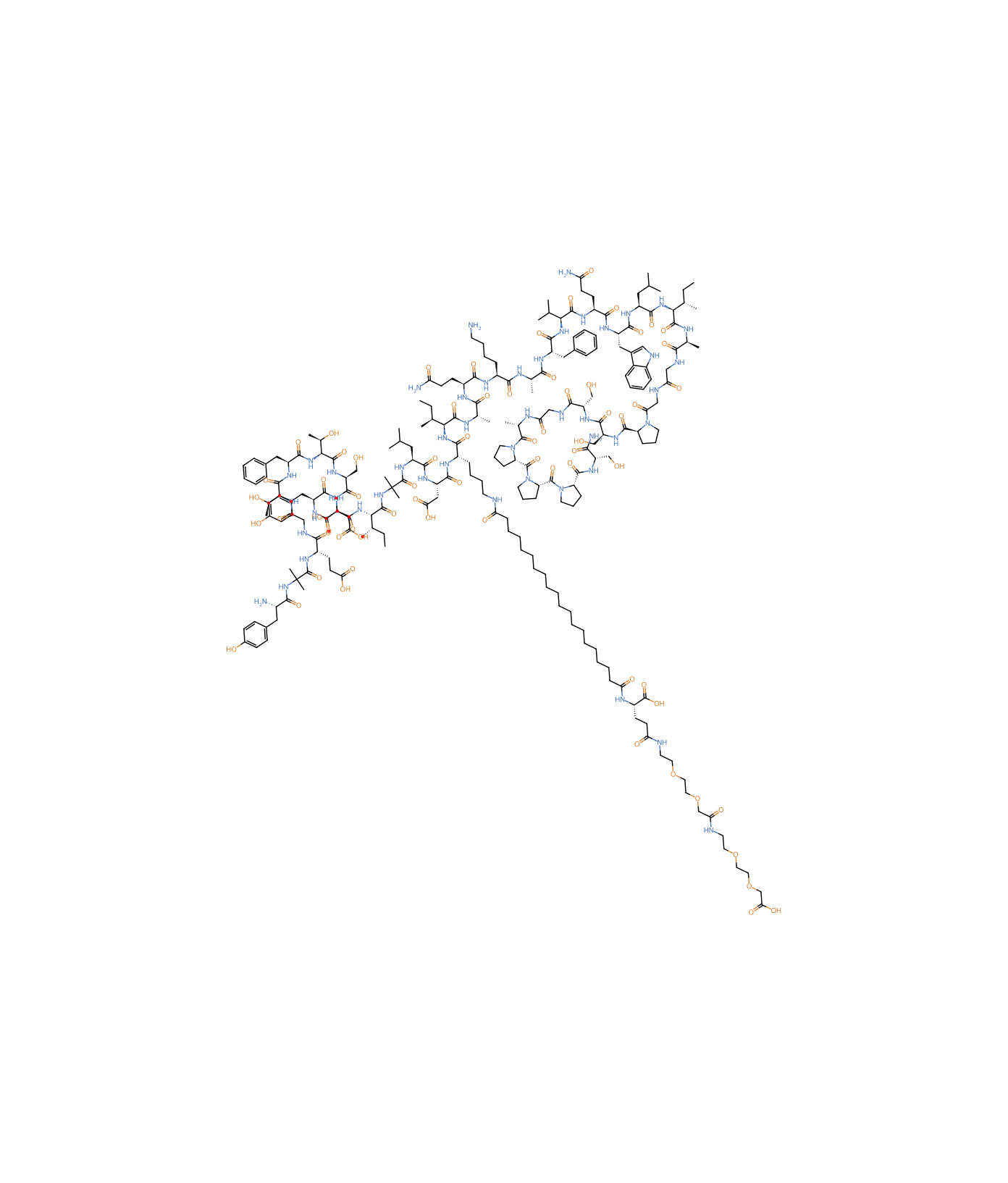
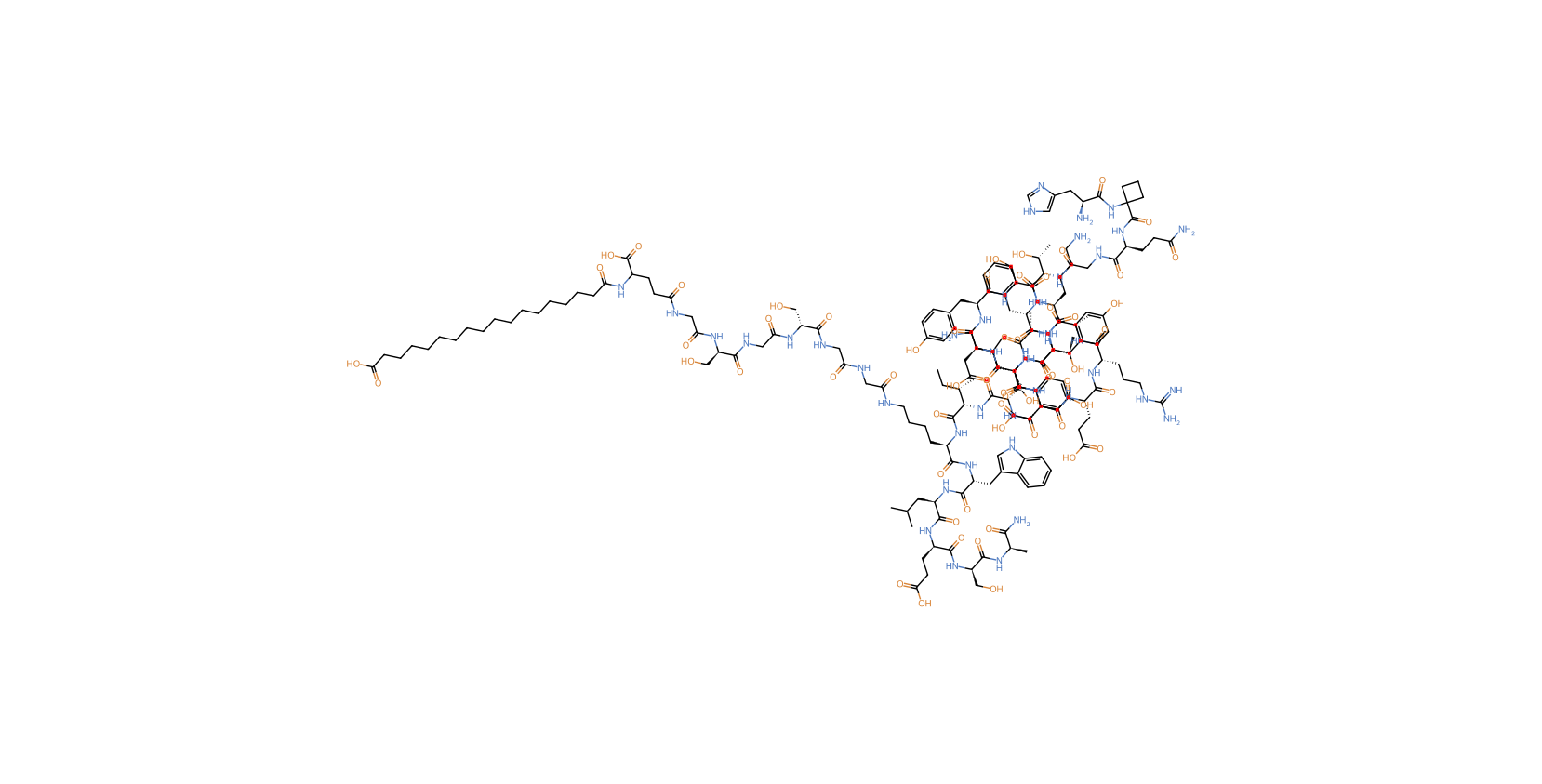
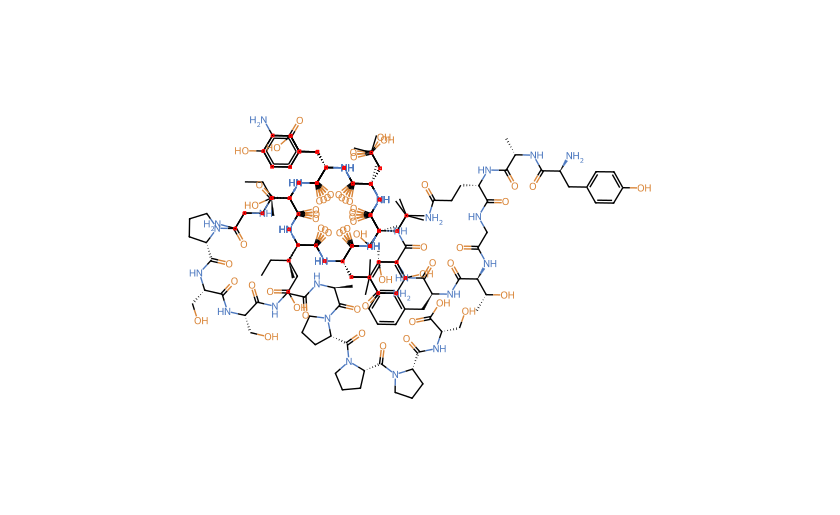
| Molecular/sequence identity | 39-residue GIP-backbone triple agonist (Tyr-Aib-Gln-Gly-Thr-Phe-…-Pro-Pro-Pro-Ser-NH2) with Aib at positions 2 and 20, alpha-methyl-leucine at 13, and a C20 fatty-diacid conjugate at Lys17 (CAS 2381089-83-2) |
| Modifications/form | Solution for Administered into the tissue layer under the skin. Quelle der Definition: Neutral gloss; usage context: Routes, devices, and absorption primer · Glossar injection; C-terminal fatty-acid moiety enabling once-weekly dosing |
| Stable identifiers | WHO INN proposed; no current USAN listing; CAS and DrugBank identifiers pending regulatory filing |
| Identity caveats | Sequence and modification chemistry are now characterized in the peer-reviewed literature and chemical registries (CAS 2381089-83-2; see PMC11908972). Earlier versions of this entry predated full public characterization (updated 2026-08-08). |
Development and approval status
| Jurisdiction | Status and indication | Product/source | As of |
|---|---|---|---|
| US (FDA) | Not approved; Phase 3 trials ongoing | Eli Lilly | Aug 2026 |
| EU (EMA) | Not approved; Phase 3 trials ongoing | Eli Lilly | Aug 2026 |
| Clinical development | Phase 3 TRIUMPH program for obesity; TRANSCEND program for T2D | Eli Lilly | Aug 2026 |
- UNITED STATES
- US (FDA): Not approved; Phase 3 trials ongoing
- EU/EEA
- EU (EMA): Not approved; Phase 3 trials ongoing
- UNITED KINGDOM
- No UNITED KINGDOM row is present in the source status table
- OTHER DOCUMENTED
- Clinical development: Phase 3 TRIUMPH program for obesity; TRANSCEND program for T2D
Sport status: WADA: Retatrutide fits the S0 definition if it is a pharmacological substance not otherwise addressed and lacks approval by any governmental regulatory authority for human therapeutic use. A TUE does not change a substance's prohibited status; eligibility is determined case by case under the ISTUE criteria.
Mechanism and pharmacology
Retatrutide is a single-peptide triple agonist designed for balanced activity at the GIP, GLP-1, and glucagon receptors. GIP and GLP-1 agonism promote insulin secretion and appetite suppression; glucagon receptor agonism increases energy expenditure via hepatic lipid oxidation and thermogenesis. The triple mechanism is hypothesized to produce greater weight loss than dual agonists. A Phase 2 liver-fat sub-study reported an 81–86% relative reduction in hepatic fat fraction, suggesting activity beyond glycemic and body-weight endpoints.
Evidence by claim
| Claim/indication | Stage | Grade | Best human evidence | Main result | Important limitations |
|---|---|---|---|---|---|
| Chronic weight management | Phase 3 [1] | B | TRIUMPH-1 (May 2026, 80 wk, n~~2,500) | Mean weight loss 28.3% (12 mg); extension to 104 wk: 30.3% | No approved comparator; A study in which participants and investigators know what is administered. Quelle der Definition: Neutral gloss; usage context: Evidence grading methodology · Glossar extension phase; durability beyond 2 yr not established |
| Weight management + T2D | Phase 3 [1] | B | TRIUMPH-2 (Jul 2026, n=1,152) | Mean weight loss 20.8% (12 mg) | Adults with T2D only; active comparators not reported |
| Weight management + CVD | Phase 3 [1] | B | TRIUMPH-3 (Jul 2026, n=1,946) | Mean weight loss 22.6% (12 mg) | CV outcome data not yet reported separately |
| Glycemic control in T2D | Phase 3 [1] | B | TRANSCEND-T2D-1 (Jun 2026, n=537) | HbA1c reduction 1.7–2.0 pp; weight loss up to 16.8% | Published Jun 2026 (Lancet); duration 40 wk |
| Knee OA + obesity | Phase 3 | B | TRIUMPH-4 (Dec 2025, n~~1,000) | Mean weight loss 28.7% | OA-specific functional outcomes not yet published |
- AKlasse A: Für eine bestimmte gekennzeichnete Anwendung nachgewiesen
- BKlasse B: Mäßige Humanstudien
- CKlasse C: Vorläufige Humanstudien
- DKlasse D: Nur präklinisch
- EKlasse E: Anekdotisch/Vermarktungsbehauptung
- XKlasse X: Die Evidenz widerspricht der Behauptung oder stützt sie nicht
Text alternative for the claim-evidence diagram. Each grade is defined below:
- A — Established for a specific labeled use
- 0 claims
- B — Moderate human evidence
- 5 claims: Chronic weight management; Weight management + T2D; Weight management + CVD; Glycemic control in T2D; Knee OA + obesity
- C — Preliminary human evidence
- 0 claims
- D — Preclinical only
- 0 claims
- E — Anecdotal/marketing claim
- 0 claims
- X — Evidence contradicts or does not support the claim
- 0 claims
Key studies
| Study | Design/population | Exposure studied | Endpoints and result | Limitations |
|---|---|---|---|---|
| Phase 2 dose-finding (NEJM 2023; NCT04881760) | Phase 2, A study in which participants are assigned to the study material or a comparator by chance. Quelle der Definition: Neutral gloss; usage context: Evidence grading methodology · Glossar, 48 wk; adults with obesity (n=338; T2D excluded) | Retatrutide 1–12 mg Administered into the tissue layer under the skin. Quelle der Definition: Neutral gloss; usage context: Routes, devices, and absorption primer · Glossar qwk | Mean weight loss 24.2% (12 mg); liver fat reduction 81–86% (MRI-PDFF) | Short duration for weight-loss plateau; MRI-PDFF measured in subset only |
| TRIUMPH-1 (NCT05929066) | Phase 3, RCT, 80 wk; adults with obesity or overweight + comorbidity (n=2,335) [1] | Retatrutide vs An inactive comparator used in a controlled study. Quelle der Definition: Neutral gloss; usage context: Evidence grading methodology · Glossar SC qwk | Mean weight loss 28.3% (12 mg); extension to 104 wk: 30.3% | Topline press release; full manuscript not yet peer reviewed |
| TRIUMPH-2 (NCT05929079) | Phase 3, RCT; obesity + T2D (n=1,152) [1] | Retatrutide vs placebo SC qwk | Mean weight loss 20.8% (12 mg) at 80 wk | Results from press release; not yet published |
| TRIUMPH-3 (NCT05882045) | Phase 3, RCT; obesity + established CVD (n=1,946) [1] | Retatrutide vs placebo SC qwk | Mean weight loss 22.6% (12 mg) at 80 wk | CV outcome results not separately reported |
| TRANSCEND-T2D-1 (NCT06354660) | Phase 3, RCT, 40 wk; T2D diet/exercise-controlled (n=537) [1] | Retatrutide doses vs placebo | HbA1c −1.7 to −2.0 pp; weight loss up to −16.8% | Published Jun 2026 in The Lancet; PMID 42250575 |
Dose and administration evidence
Approved labeled regimen
Not applicable — no marketing authorization was identified in the major regulator databases reviewed as of the verification date.
Studied regimens (not recommendations)
No established or recommended human dose.
Phase 2 and Phase 3 trials employed once-weekly Administered into the tissue layer under the skin. Quelle der Definition: Neutral gloss; usage context: Routes, devices, and absorption primer · Glossar administration with dose-escalation schedules. Phase 2 tested doses of 1, 4, 8, 12 mg; Phase 3 TRIUMPH/TRANSCEND programs use up to 12 mg weekly as the highest studied dose. Titration typically began at 2 mg.
What is not established
No safe or effective dose has been confirmed by regulatory review. Maximum tolerated dose, optimal titration rate, long-term safety (>2 years), and efficacy in diverse populations are not established.
Safety
Established label risks
Not applicable — no approved label exists.
Human-study signals
GI adverse events (nausea, vomiting, diarrhea) most common, similar to other incretin-based therapies.
Discontinuations due to GI events reported in Phase 2 and Phase 3; rates titration-dependent.
Heart rate increase (~2–6 bpm) observed.
Injection-site reactions reported.
No pancreatitis signal identified in available data, but follow-up limited.
Unknowns and product-quality risks
No long-term safety data beyond 2 years.
Carcinogenicity, cardiovascular safety, and pancreatic safety not characterized.
Substance is A clinical-stage candidate with scientific or public relevance. Investigation is not approval, and a studied exposure is not a recommendation. Quelle der Definition: Scope and selection methodology · Glossar; any material sold as "retatrutide" may differ in identity, purity, and strength from the clinical trial material.
Interactions and special populations
Drug–drug: Likely delays gastric emptying, potentially affecting oral drug absorption; no formal interaction studies published.
Pregnancy/lactation: No data.
Pediatric: Not studied.
Renal/hepatic impairment: No data.
Regulatory, compounding, and sport notes
Regulatory status: No marketing authorization was identified in the major regulator databases reviewed; Phase 3 development is ongoing.
The World Anti-Doping Agency; its Prohibited List classifies many peptides as prohibited substances in sport. Quelle der Definition: WADA and sport regulation brief · Glossar: Retatrutide fits the WADA Prohibited List class S0 (non-approved substances): pharmacological substances not addressed elsewhere in the list and with no current approval by any governmental regulatory health authority for human therapeutic use. Quelle der Definition: WADA and sport regulation brief · Glossar definition if it is a pharmacological substance not otherwise addressed and lacks approval by any governmental regulatory authority for human therapeutic use. A A Therapeutic Use Exemption can authorize qualifying use of a prohibited substance; it does not change the prohibited classification. Quelle der Definition: WADA and sport regulation brief · Glossar does not change a substance's prohibited status; eligibility is determined case by case under the ISTUE criteria.
US compounding: FDA states that retatrutide cannot be used in compounding under federal law and is not a component of an FDA-approved drug. Other jurisdictions require separate current legal review.
Drug shortages: Not applicable — product is not marketed.
Evidence gaps
No CVOT data. No direct comparisons against semaglutide 2.0 mg or tirzepatide 15 mg. No long-term (≥5-year) safety data. No data on quality of unapproved commercial supply.
Search notes
Databases and registries: ClinicalTrials.gov, PubMed, FDA INN database.
Search terms: "retatrutide", "LY3437943", "TRIUMPH", "TRANSCEND-T2D", "NCT04881760".
Last searched: 2026-08-06.
Inclusion emphasis: Published Phase 1/2 studies, Phase 3 trial registries, and press releases from the sponsor (Eli Lilly) where peer-reviewed publication is not yet available.
Sources
Rosenstock J, Frias JP, Rodriguez A, et al. Retatrutide, a GIP, GLP-1 and glucagon receptor agonist, for people with type 2 diabetes: a randomised, double-blind, placebo and active-controlled, parallel-group, phase 2 trial. Lancet. 2023;402(10408):529–540. DOI: 10.1016/S0140-6736(23)01053-X. PMID: 37385280. https://doi.org/10.1016/S0140-6736(23)01053-X
Jastreboff AM, Kaplan LM, Frías JP, et al. Triple-hormone-receptor agonist retatrutide for obesity — a Phase 2 trial. N Engl J Med. 2023;389(6):514– 526. DOI: 10.1056/NEJMoa2301972. PMID: 37366315. https://doi.org/10.1056/NEJMoa2301972
ClinicalTrials.gov. TRIUMPH-1 (NCT05929066). Eli Lilly. Updated Jun 2026. Accessed 2026-08-06. https://clinicaltrials.gov/ct2/show/NCT05929066
ClinicalTrials.gov. TRIUMPH-2 (NCT05929079). Eli Lilly. Updated Jul 2026. Accessed 2026-08-06. https://clinicaltrials.gov/ct2/show/NCT05929079
ClinicalTrials.gov. TRIUMPH-3 (NCT05882045). Eli Lilly. Updated Jul 2026. Accessed 2026-08-06. https://clinicaltrials.gov/ct2/show/NCT05882045
ClinicalTrials.gov. TRANSCEND-T2D-1 (NCT06354660). Eli Lilly. Updated Mar 2026. Accessed 2026-08-06. https://clinicaltrials.gov/ct2/show/NCT06354660
Bajaj HS, et al. Efficacy and safety of retatrutide in T2D (TRANSCEND-T2D-1). Lancet. 2026;407(10546):2402–2413. DOI: 10.1016/S0140-6736(26)00967-0. PMID: 42250575. https://pubmed.ncbi.nlm.nih.gov/42250575/
Eli Lilly. TRIUMPH-1 and TRANSCEND-T2D-1 topline results press releases. 2025–2026. Accessed 2026-08-06. https://lilly.mediaroom.com/
US Food and Drug Administration. FDA's Concerns with Unapproved GLP-1 Drugs Used for Weight Loss (retatrutide and cagrilintide compounding statement). Updated 2026. https://www.fda.gov/drugs/postmarket-drug-safety-information-patients-and-providers/fdas-concerns-unapproved-glp-1-drugs-used-weight-loss