Bottom line
Oritavancin is a semisynthetic lipoglycopeptide with three mechanisms of action (dual cell-wall synthesis inhibition and membrane disruption) and a very long The time for the amount of a substance in the body to fall by half. 定义来源: Neutral gloss; usage context: Routes, devices, and absorption primer · 术语表 (~245 h). It is FDA-approved as a single 1,200 mg Administered into a vein. 定义来源: Neutral gloss; usage context: Routes, devices, and absorption primer · 术语表 infusion for ABSSSI, offering a complete treatment course in one dose. Two products (Orbactiv and Kimyrsa) have different infusion durations (3 h vs 1 h) and preparation instructions.
Identity and composition
| Field | Verified information |
|---|---|
| Preferred name | Oritavancin |
| Key aliases | Orbactiv, Kimyrsa, LY333328 |
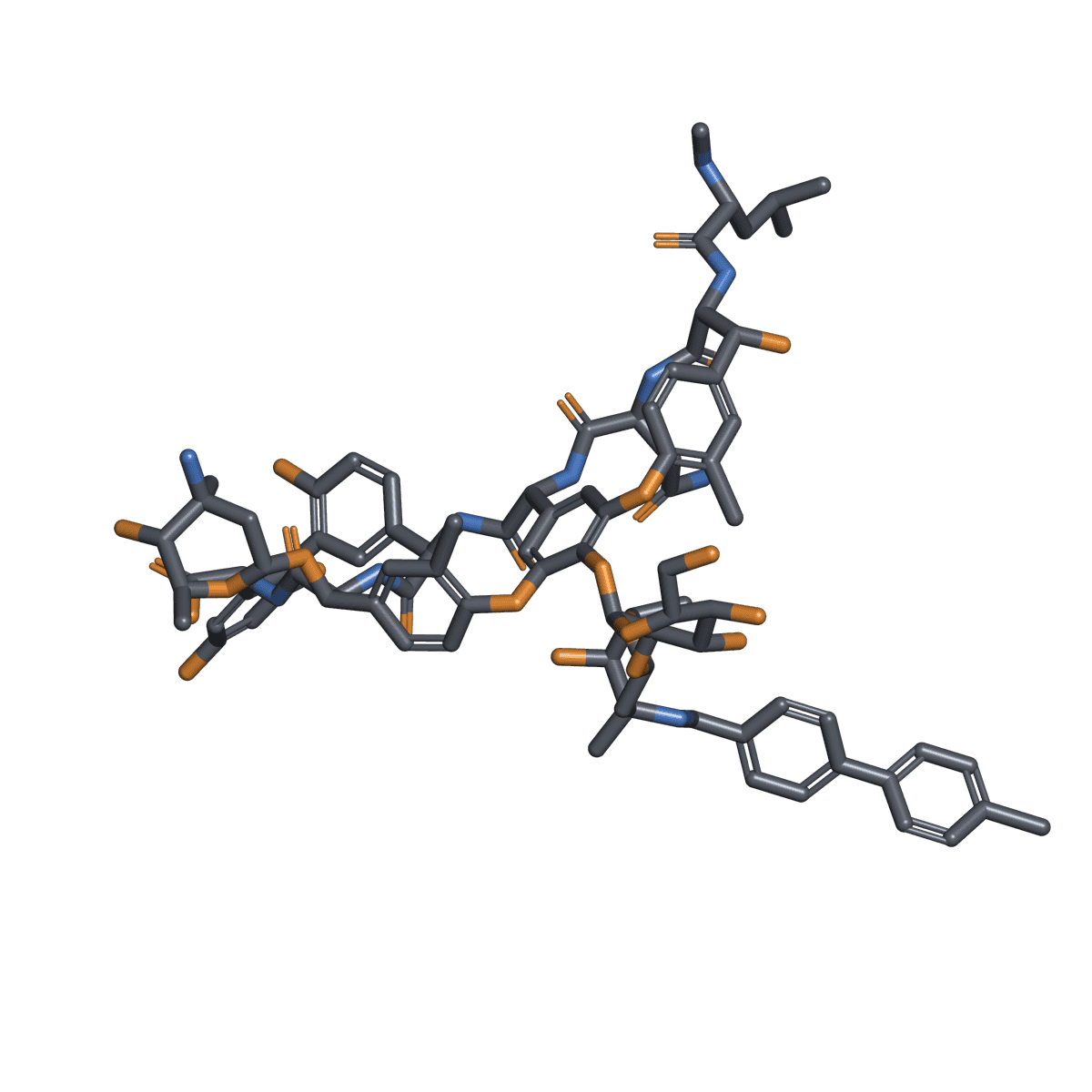
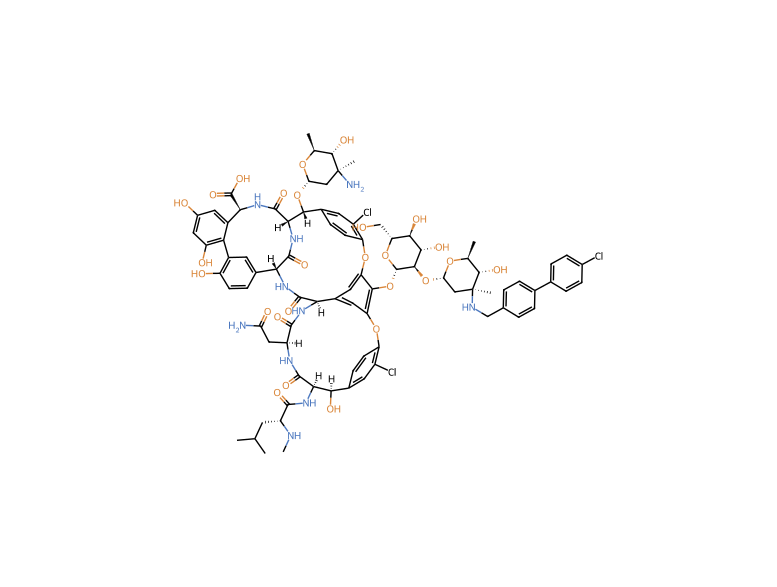
| Molecular/sequence identity | Semisynthetic lipoglycopeptide derivative of vancomycin with a 4'-chlorobiphenylmethyl group attached to the disaccharide amino group. Chemical name: [4"R]-22-O-(3-amino-2,3,6-trideoxy-3-C-methyl-α-L-arabino-hexopyranosyl)-N3''-[(4'-chloro[1,1'-biphenyl]-4-yl)methyl] vancomycin phosphate [1:2] [salt]. |
| Modifications/form | Diphosphate salt; Freeze-drying: water is removed by sublimation under reduced pressure, which can improve the stability of peptides and yield a porous dry matrix. Water removal does not sterilize a product, prove its quality, or define how it should later be handled. 定义来源: Lyophilization, formulation, and stability primer · 术语表 powder for Administered into a vein. 定义来源: Neutral gloss; usage context: Routes, devices, and absorption primer · 术语表 infusion. Orbactiv — 3 h infusion; Kimyrsa — 1 h infusion (different formulation). |
| Stable identifiers | The record number of a compound in PubChem, the atlas's primary structure-asset source. A registry record or depiction does not authenticate a commercial sample. 定义来源: Identity and structure assets methodology · 术语表: 16136912; DrugBank: DB06404; ChEBI: CHEBI:136535; CAS: 171099-57-3 |
| Identity caveats | Two distinct commercial products have different doses, infusion durations, and preparation requirements. Oritavancin is a lipoglycopeptide, not a natural peptide. |
Development and approval status
| Jurisdiction | Status and indication | Product/source | As of |
|---|---|---|---|
| USA (FDA) | Approved — ABSSSI (adults) | Orbactiv (The Medicines Company); Kimyrsa (Melinta) | 2014 |
| EU (EMA) | Approved — ABSSSI (adults) | Orbactiv | 2015 |
- UNITED STATES
- USA (FDA): Approved — ABSSSI (adults)
- EU/EEA
- EU (EMA): Approved — ABSSSI (adults)
- UNITED KINGDOM
- No UNITED KINGDOM row is present in the source status table
- OTHER DOCUMENTED
- No OTHER DOCUMENTED row is present in the source status table
Sport status: WADA status: not prohibited. No US federal CSA scheduling was identified as of 2026-08-06; state law and other jurisdictions were not assessed. US and EU authorizations for ABSSSI are product-specific.
Mechanism and pharmacology
Oritavancin has three mechanisms of action:
Inhibition of transglycosylation (polymerization) of peptidoglycan by binding to the stem peptide.
Inhibition of transpeptidation (cross-linking) by binding to the peptide bridging segments.
Disruption of bacterial membrane integrity, causing depolarization, permeabilization, and cell death.
These multiple mechanisms contribute to concentration-dependent bactericidal activity.
How a substance is absorbed, distributed, metabolized, and eliminated by the body; atlas pages report pharmacokinetic data such as half-life, metabolism, and clearance. 定义来源: Neutral gloss; usage context: Routes, devices, and absorption primer · 术语表: Administered into a vein. 定义来源: Neutral gloss; usage context: Routes, devices, and absorption primer · 术语表; The time for the amount of a substance in the body to fall by half. 定义来源: Neutral gloss; usage context: Routes, devices, and absorption primer · 术语表 ~245-393 h; extensive tissue distribution; high protein binding (~85-90%); primarily feces excretion (unchanged); not CYP450 metabolized.
Evidence by claim
| Claim/indication | Stage | Grade | Best human evidence | Main result | Important limitations |
|---|---|---|---|---|---|
| ABSSSI (adults) | Approved | A | Two identically designed phase 3 A study in which participants are assigned to the study material or a comparator by chance. 定义来源: Neutral gloss; usage context: Evidence grading methodology · 术语表 (SOLO I/II; N=1,987); oritavancin 1,200 mg single dose vs vancomycin 1 g q12h × 7-10 d | ECR (48-72 h): 82.3% vs 78.9% (SOLO I); 80.1% vs 82.9% (SOLO II) — both met NI margin (-10%) | Heterogeneous comparator duration; no pediatric data |
Text alternative for the claim-evidence diagram. Each grade is defined below:
- A — Established for a specific labeled use
- 1 claim: ABSSSI (adults)
- B — Moderate human evidence
- 0 claims
- C — Preliminary human evidence
- 0 claims
- D — Preclinical only
- 0 claims
- E — Anecdotal/marketing claim
- 0 claims
- X — Evidence contradicts or does not support the claim
- 0 claims
Key studies
| Study | Design/population | Exposure studied | Endpoints and result | Limitations |
|---|---|---|---|---|
| SOLO I (NCT01252719) | Phase 3, DB, A study in which participants are assigned to the study material or a comparator by chance. 定义来源: Neutral gloss; usage context: Evidence grading methodology · 术语表; N=954; ABSSSI | Oritavancin 1,200 mg single Administered into a vein. 定义来源: Neutral gloss; usage context: Routes, devices, and absorption primer · 术语表 dose vs vancomycin q12h × 7-10 d | ECR: 82.3% vs 78.9% (difference 3.4%, 95% CI -1.6, 8.4) — NI met | Vancomycin not blinded after day 10; 80% male in oritavancin arm |
| SOLO II (NCT01252732) | Phase 3, DB, RCT; N=1,005; ABSSSI | Same regimen | ECR: 80.1% vs 82.9% (difference -2.7%, 95% CI -7.5, 2.0) — NI met | Slightly lower oritavancin response vs SOLO I |
Dose and administration evidence
Approved labeled regimen
The label summary below is product-, indication-, and jurisdiction-specific; consult the full current label and a licensed clinician/pharmacist.
Orbactiv: 1,200 mg Administered into a vein. 定义来源: Neutral gloss; usage context: Routes, devices, and absorption primer · 术语表 single dose over 3 h. Kimyrsa: 1,200 mg IV single dose over 1 h. No dose adjustment needed for mild or moderate renal or hepatic impairment (severe impairment not evaluated).
What is not established
Repeated dosing for complicated infections (studied but not FDA-approved).
Pediatric use (not approved).
Osteomyelitis, endocarditis, or prosthetic joint infections (off-label only).
Safety
Established label risks
Nausea, vomiting, headache, diarrhea, phlebitis, infusion-site pain.
Elevation of ALT/AST (incidence 2-8%).
Headache (most common AE).
Infusion reactions (flushing, pruritus, urticaria).
Osteomyelitis (noted as a post-treatment complication in some patients, likely reflecting disease progression rather than drug effect).
Human-study signals
Isolated reports of Clostridioides difficile infection following therapy.
No QTc prolongation signal.
Unknowns and product-quality risks
Two distinct products (Orbactiv, Kimyrsa) with different preparation instructions and infusion durations — not interchangeable without adjustment.
Must not be mixed with saline-containing diluents (use D5W only for Orbactiv; Kimyrsa compatible with saline).
Interactions and special populations
Coagulation test interference: oritavancin artificially prolongs aPTT for up to 120 h, PT/INR for up to 12 h, ACT for up to 24 h, and D-dimer for up to 72 h after a single dose. Use non-phospholipid-dependent tests (e.g., chromogenic Factor Xa assay) if aPTT monitoring is needed within 120 h. Contraindicated with Administered into a vein. 定义来源: Neutral gloss; usage context: Routes, devices, and absorption primer · 术语表 unfractionated heparin for 120 h (5 days) after oritavancin administration because aPTT monitoring becomes unreliable; oritavancin does not anticoagulate in vivo. Weak inhibitor of CYP2C19 and CYP3A4; weak inducer of CYP3A4 and CYP2D6. No dose adjustment needed for mild or moderate renal or hepatic impairment (severe impairment not evaluated). Pregnant/lactating: no adequate data.
Regulatory, compounding, and sport notes
The World Anti-Doping Agency; its Prohibited List classifies many peptides as prohibited substances in sport. 定义来源: WADA and sport regulation brief · 术语表 status: not prohibited. No US federal CSA scheduling was identified as of 2026-08-06; state law and other jurisdictions were not assessed. US and EU authorizations for ABSSSI are product-specific.
Evidence gaps
Single-dose vs multi-dose regimens for deep-seated infections.
Use in patients weighing >120 kg (limited How a substance is absorbed, distributed, metabolized, and eliminated by the body; atlas pages report pharmacokinetic data such as half-life, metabolism, and clearance. 定义来源: Neutral gloss; usage context: Routes, devices, and absorption primer · 术语表 data).
Resistance mechanism: in vitro serial passage studies show S. aureus and E. faecalis can develop reduced susceptibility.
Comparison with dalbavancin (the two have never been directly compared in an A study in which participants are assigned to the study material or a comparator by chance. 定义来源: Neutral gloss; usage context: Evidence grading methodology · 术语表).
Search notes
Databases and registries: FDA label (accessdata.fda.gov), DailyMed, ClinicalTrials.gov, PubMed
Search terms: oritavancin, Orbactiv, Kimyrsa, lipoglycopeptide, ABSSSI, SOLO trial
Last searched: 2026-08-06
Inclusion emphasis: FDA/EMA labels, phase 3 A study in which participants are assigned to the study material or a comparator by chance. 定义来源: Neutral gloss; usage context: Evidence grading methodology · 术语表
Sources
FDA prescribing information: ORBACTIV (oritavancin) for injection. Available at: https://www.accessdata.fda.gov/drugsatfda_docs/label/2021/206334s006lbl.pdf (accessed 2026-08-06).
DailyMed: ORBACTIV. Available at: https://dailymed.nlm.nih.gov/dailymed/drugInfo.cfm?setid=ff09a726-9f9b-4e30-b509-396781293220 (accessed 2026-08-06).
Corey GR, et al. Single-dose oritavancin in the treatment of acute bacterial skin infections. N Engl J Med. 2014;370(23):2180-90. DOI: 10.1056/NEJMoa1310422. (SOLO I)
Corey GR, et al. Single-dose oritavancin versus 7-10 days of vancomycin in the treatment of gram-positive acute bacterial skin and skin structure infections: the SOLO II noninferiority study. Clin Infect Dis. 2015;60(2):254-62. DOI: 10.1093/cid/ciu778.